Get Full Government Meeting Transcripts, Videos, & Alerts Forever!
Get email alerts on the Animal Ordinance Amendments topic
No spam. Unsubscribe anytime.
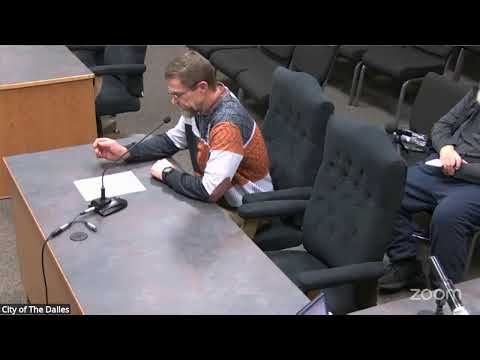
Council hears hours-long public comment on proposed animal ordinance changes
Summary
City staff presented a broad set of proposed amendments to The Dalles municipal animal-control rules and invited public feedback. Proposals would add new permit criteria, define household pets vs. livestock, set setbacks and lot-size limits for animals and create a revocation and appeal process; council asked staff to return with revisions.
City Manager Matthew Clebs and the city attorney presented proposed revisions to the Dallas Municipal Code’s animal-control chapter at the Feb. 24 City Council meeting, opening a nearly three-hour public discussion on livestock, poultry and household pets.
The proposed changes would (as drafted) add definitions for “continuous annoyance,” household pets, livestock and prohibited animals; create a livestock-permit program with issuance criteria, inspections and an appeal to Municipal Court; set minimum lot-size/animal-count standards informed by the League of Oregon Cities model ordinance; and raise some penalties.
“Tonight we’ll be looking at animals and prompting some of this discussion and community feedback that we hope to get,” City Manager Matthew Clebs said at the start of the item. City Attorney Jonathan (city attorney) told the council staff’s approach was to “put all of the ideas that have been developing over the past year ... on the table,” and to solicit council and public guidance before returning the ordinance as an action item.
The draft would treat animals in three categories: household pets (dogs, cats, hamsters, guinea pigs and similar animals, proposed as not requiring permits), livestock (proposed to require permits and to include chickens, ducks, rabbits and “similarly sized” animals), and prohibited animals (all others, permitted only in narrow circumstances such as educational displays or vegetation management).
The ordinance as drafted includes several specific provisions that drew question from councilors and the public: a placeholder “nonconforming” cutoff date (July 1 in the packet) that would allow existing animals to remain if registered; proposed minimum setbacks of 10–25 feet from neighboring dwellings or structures; a numerosity table that ties allowed animals to lot size (taken from the LOC model); an appeal path to Municipal Court; and an expanded definition of public nuisance tied to sanitation, repeated escapes and odors. The draft increases some fines (for example, a general violation penalty from $1,250 to $1,500 as proposed).
Animal Control Officer Jake Baker, who appeared with codes staff and the police chief, said enforcement guidance shaped several proposals. “Four times does sound reasonable” as a starting point for repeated escapes that could justify permit revocation, Baker told the council when asked about the number of escapement incidents needed to trigger enforcement action.
Residents and animal owners made lengthy public comments. Debbie Richlder (924 E. 19th St.), who identified her property as rural residential inside city limits, urged the council to “grandfather in the properties that are zoned rural residential” and warned against rules that she said would change a long-standing rural lifestyle. “If it’s not broke, don’t fix it,” she told the council.
Julie Krueger, a longtime backyard poultry keeper, described typical flock dynamics and asked councilors to avoid hard numeric limits that would force owners to dispose of older birds. “You can never have one chicken because chickens are social,” Krueger said, explaining why household flocks often grow and evolve.
Other speakers, including property owners who keep horses and goats, urged exemptions or different rules for larger parcels on the city edge and said they rely on animals for vegetation management and family activities. Several residents and councilors also urged the council to focus enforcement on nuisance cases rather than sweeping prohibitions.
Councilors asked staff to return with revisions. Specific requests included: clarifying whether pot‑bellied pigs should be classified as household pets or livestock; refining the definition and remedies for “continuous annoyance”; reconsidering the exact setback measurements; and tailoring numerosity or lot‑size limits to species (for example, treating poultry, rabbits and horses differently).
Mayor Mace asked the council to limit questions during the public comment period and to deliberate after hearing from citizens. Councilors emphasized the community’s rural character and the value several residents placed on keeping animals in town, but they also said rules are needed to address public-health, sanitary and repeated‑nuisance problems. Several councilors and staff said they favored a more targeted set of changes rather than the full draft as written.
The item was a discussion only; no ordinance was adopted. Staff said it would incorporate council direction and public input and bring a revised draft back for action at a future meeting.
Residents who raised specific operational questions — how nonconforming animals would be handled, whether permits would be annual, and how replacements would be treated when an animal dies — were told those details could be adjusted and brought back. The council asked staff to consult additional subject-matter experts, examine the LOC-derived numerosity table and consider exemptions for parcels that are rural residential in existing zoning.
The council recessed for a short break after the item. Staff indicated they would return with a revised ordinance informed by tonight’s comments and by further review with public‑health and veterinary stakeholders.