
Tazewell County highlights volunteer emergency-management program, proclaims August Emergency Management Awareness Month
Get AI-powered insights, summaries, and transcripts
Subscribe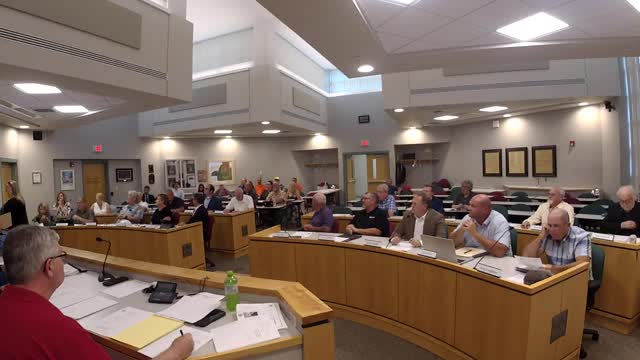
Summary
Tazewell County emergency-management staff outlined the agency’s core functions and volunteer response teams during a county board meeting and presented a proclamation recognizing August 2025 as Emergency Management Awareness Month.
Tazewell County emergency-management staff outlined the agency’s core functions and volunteer response teams during a county board meeting and presented a proclamation recognizing August 2025 as Emergency Management Awareness Month.
The proclamation, included in the meeting packet, urges appreciation for emergency managers and aligns the county’s observance with National Preparedness Month in September. The board considered the proclamation as part of communications from elected and appointed officials.
Dawn Cook, who presented on behalf of Tazewell County Emergency Management, described everyday operations, planning responsibilities and how the office supports response and long-term recovery. “We do planning and preparedness activities. That’s a lot of what we do kind of every day,” Cook said.
Cook said the emergency management office is a small staff: one full-time employee, two part-time employees and a volunteer corps organized into teams. “We have 50 volunteers, and I have 5 team leads,” she said. She later referred to about 45 active members who regularly respond.
Cook described three volunteer teams: a communications team, a unified command-post team and a search-and-rescue/drone team that conducts thermal-imaging drone operations. She said volunteers respond around the clock and that typical responses can include searches for missing people and evidence searches for criminal investigations; she cited a case in which volunteers located a bullet that contributed to a homicide prosecution.
The office logs volunteer time through an online tracker. Cook said volunteers have contributed more than 2,100 hours so far this year and the office is trending toward roughly 3,000 hours for the year. She noted the county pays a modest call-out stipend: $10 per call-out, a recent increase from $6, and that volunteers supply their own search-and-rescue packs and other personal equipment.
Cook described systems the office uses for public alerts and volunteer notification. The county now uses the Integrated Public Alert and Warning System (iPAWS) to reach residents and subscribes to an alerting platform called I’m Responding to notify volunteers; the I’m Responding subscription costs about $500 per year. “They can say, ‘I can be there in 15 minutes,’ or ‘I can’t come,’ so then we know how many people are coming,” Cook said.
She described recent exercises and outreach: a full-scale exercise in Tremont last October drew more than 120 participants; the county is participating in a Tri-County Business Partnership for Resilience and Emergency Planning with Peoria and Woodford counties; and the office conducts monthly team trainings in addition to a general-membership meeting on the second Thursday of each month. Cook said a volunteer appreciation night is scheduled each October on the second Thursday.
Cook also described planning requirements tied to state accreditation, including five required plans for the Illinois Emergency Management Agency and a local hazard-mitigation plan. She said emergency management coordinates with municipal first responders, regional and state partners, and federal agencies as needed.
Board members asked operational questions about reimbursement, meeting cadence and the alerting platform. On reimbursement, Cook said there is no mileage reimbursement; volunteers receive the $10 call-out stipend and purchase required personal equipment themselves.
The presentation concluded with the board receiving the materials and the members invited to attend volunteer meetings. Cook offered her contact card and invited board members and the public to observe training and exercises.
Less critical details: Cook said the office’s Emergency Operations Center sits across from the public health department, and volunteers’ tracked hours are used to estimate the program’s value if those hours were paid at market rates.