Get Full Government Meeting Transcripts, Videos, & Alerts Forever!
Get email alerts on the District Goals topic
No spam. Unsubscribe anytime.
New Berlin board discusses 3–5 year goals, student achievement dashboard and career-readiness metrics
Summary
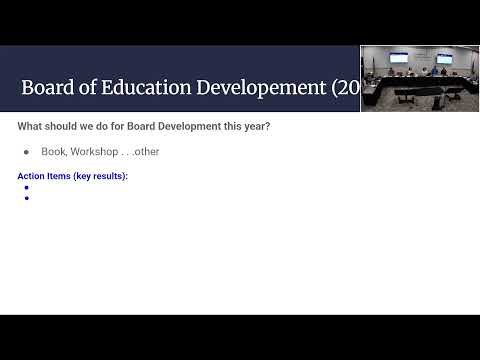
In a work session following the district meeting, the Board of Education reviewed framework for multi-year goals, discussed the district dashboard and college-and-career-readiness metrics, and weighed tracking career internships and financial-literacy instruction; board members also debated staff-survey targets and retention metrics.
Board members of the School District of New Berlin spent their work session discussing objectives and measurable key results for a three- to five-year planning horizon, focusing on student achievement, college-and-career readiness, and staff metrics.
The discussion centered on how the district dashboard and a separate college-and-career-readiness (CCR) dashboard should be used to set specific, measurable goals — for example, whether the board should set targets for ACT scores, graduation rates, participation in dual-enrollment or technical programs, or percentages of students engaged in internships or job shadowing.
One board member asked for explicit multi-year goals tied to dashboard metrics: “I think we should really go through and pick some high level goals… Do we want to improve [ACT] by a half a point in three years?” the board member asked. District staff responded that the CCR dashboard captures internships, apprenticeships and dual-enrollment activity and that the administration can provide data breakdowns to underpin targets.
Administrators cautioned that changes at the Wisconsin Department of Public Instruction (DPI) make year-to-year comparisons of state standardized test results difficult. A board member noted that DPI’s recent changes to test design and scoring have complicated longitudinal comparisons and that using the dashboard primarily for relative comparisons to other districts may be more reliable than strict year-to-year tracking.
Allison (administrative staff) suggested expanding internships, job-shadowing, and career exploration partnerships with local businesses and trades, and integrating “financial literacy and essential life skills into career readiness courses.” Staff said the district already tracks levels of workforce preparation — from job-shadowing through apprenticeships and WCTC coursework — and that those data feed the CCR dashboard.
On staffing metrics, the board reviewed employee-survey results used last year to set targets, when the district focused on recognition and work-life balance. District administrators reported that certified-staff intent-to-stay rates rose from 66% back to 76% after targeted actions. Board members agreed to retain the previous staff-goal framework — continuing targeted actions on the lowest-scoring survey items — and to monitor whether changes translate into longer-term retention.
Board members asked the administration to add three-year goals to the public dashboard, provide five years of historical data where possible, and bring back the CCR dashboard and related breakdowns so the board can decide specific targets at a later meeting. Members also recommended including the feasibility study and “well screen” results from the facilities task force on a future agenda to inform long-range facility planning and any capital or fundraising strategies.
No formal board motions or budget decisions were made during the discussion; the session produced direction to staff to provide additional data and to return with specific targets for board consideration.