Get Full Government Meeting Transcripts, Videos, & Alerts Forever!
Get email alerts on the Affordable Housing Tax Abatement topic
No spam. Unsubscribe anytime.
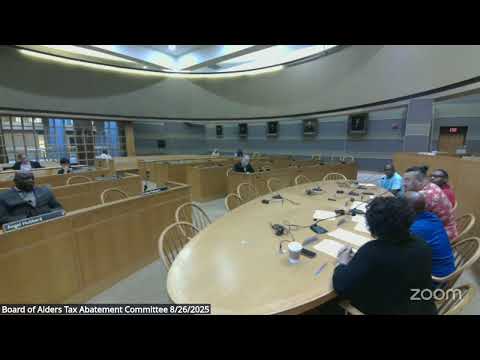
Committee approves tax-abatement deal for Winchester Lofts to convert units to long-term affordable housing
Summary
The Tax Abatement Committee approved a tax-abatement agreement for the non-profit purchaser of Winchester Lofts that will restrict roughly 75% of units as permanently affordable and provide a $2,000-per-unit annual abatement (with a 3% increase beginning year two) under a 15- or 17-year restriction, contingent on closing and ownership dates.
The New Haven Tax Abatement Committee voted to approve a tax-abatement agreement that the Merry Fund, a nonprofit organization, said will convert Winchester Lofts into a building with permanently restricted affordable units. Frank Faragher, identified as chairman of the Merry Fund board, told the committee the nonprofit is under contract to acquire the 159-unit property and intends to permanently restrict 75% of the units as affordable while leaving building services and operations largely unchanged. "We're asking you for the amount of money that would allow us to provide this permanent affordability," Faragher said.
The nonprofit proposed an abatement equivalent to $2,000 per unit annually with a 3% increase starting in year two, for either a 15- or 17-year restriction; the organization said it would accept either term but believed 17 years applied only if grant funding was used. Representatives described proposed affordable rents for restricted units as roughly $1,098 for studios, $1,298 for most one-bedrooms and about $1,300 for two-bedrooms, and estimated the conversion would affect about 120 of the 159 units. The group said it expects to close on the purchase in December if successful.
Committee members asked about occupancy (the presenter said about 90.5% occupancy) and whether tenants would be income-qualified; the nonprofit said it planned an initial income certification and a one-year transition to tenant leases that would qualify residents for reduced rents if eligible. The presenters said they will offer relocation assistance for a small number of tenants the transition may affect. The nonprofit also said it would invest in building air-filtration and window work to address dust from nearby construction.
The committee approved the abatement and attached a condition in the order: the property must be deemed owned by the applicant as of Oct. 1, 2025, and the applicant must obtain ownership by Dec. 1, 2025. Committee members voiced support for expanding permanently affordable units in the neighborhood and approved the item by voice vote. The decision follows the committee's established practice of approving tax abatements when they advance community affordability goals and satisfy procedural requirements.