
Santa Fe hearing on Rancho Viejo solar and battery storage centers on fire, plume and water risks
Get AI-powered insights, summaries, and transcripts
Subscribe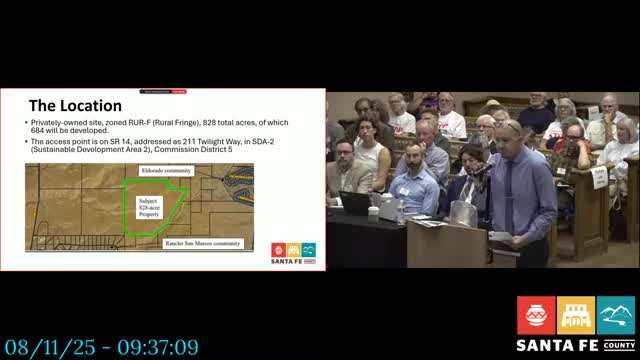
Summary
Santa Fe County staff recommended approval of a conditional use permit for Rancho Viejo Solar — a proposed 96‑megawatt solar project paired with a large battery energy storage system — but a de novo hearing on May 20 focused on whether code minima, a recent smoke/plume analysis and the proposed safety systems sufficiently protect nearby neighborhoods from fire, toxic plumes and water‑supply impacts.
Santa Fe County staff recommended approval of a conditional use permit for Rancho Viejo Solar — a proposed 96-megawatt solar facility paired with a battery energy storage system (BESS) — but the proceeding on May 20 turned into a broad technical and procedural debate over fire risk, plume modeling, water supply and whether current county codes and national standards are sufficient for utility-scale battery projects. County staff entered a report recommending approval with two dozen conditions; third-party and independent experts warned gaps remain; the applicant, AES Clean Energy, said it has added multiple safety systems and UL testing; and multiple residents described health effects and property impacts from past large-scale BESS fires elsewhere.
The County Commissioners heard four hours of testimony after staff laid out a detailed staff report and a third-party peer review from ATAR Fire. County staff’s presentation described the project site, traffic and water plans, required special reports, and recommended 23 conditions before the conditional use permit site development plan can be recorded. “The application materials were made available on a dedicated county web page,” staff said, and noted the CUP would impose conditions that must be met before a development permit is issued.
Why it matters: Rancho Viejo would pair large-scale solar with a 48-megawatt / 192-megawatt-hour (applicant figure) BESS and a 2.3-mile generation tie line on private land about 3 miles south of the city of Santa Fe. Speakers — including fire engineers, environmental scientists and community groups — said a BESS accident could release toxic gases and particulate matter over populated neighborhoods; staff and the applicant replied that the facility would be built to the county-adopted International Fire Code (2021) and to the NFPA 855 standard (2023) and that the project includes additional protections beyond minimum code.
Most important facts - Staff recommendation: County staff said the project meets Sustainable Land Development Code (SLDC) criteria subject to 23 conditions, including compliance with Santa Fe County Fire Prevention requirements, a 30-foot defensible space around the development, a 30,000‑gallon water tank for wildland/fire protection and a smoke/plume model that must be finalized before recordation of the CUP site development plan. Staff emphasized the CUP governs land use and that final building permits and code enforcement are separate processes, handled later by the Construction Industries Division and the Fire Marshal. - Third‑party fire review: Nicholas Bartlett of ATAR Fire told the commission his peer review found the project must comply with the 2021 International Fire Code and the 2023 edition of NFPA 855; ATAR concluded the applicant has proposed measures that in the reviewers’ initial read appear to exceed minimum requirements, including a thermal‑runaway‑propagation protection system (TRPP) and a redundant explosion‑control system. Bartlett said the project’s documentation is sufficient to proceed with a CUP but that “if the CUP is granted, there will be much more review” before construction permits are issued. - Applicant position: AES Clean Energy said the site is appropriate for solar, that it can deliver electricity into PNM’s grid, and that the BESS will be designed to current product and installation standards (UL listings and NFPA). AES representatives described a layered safety approach — battery management systems, gas detection, fire and alarm panels, TRPP/direct‑injection systems, deflagration venting and 24/7 remote operations monitoring — and submitted best‑available test data including UL 9540A reports. AES also noted changes made after public input (reduced panel height, a perimeter road, panel screening and a monopole transmission option). - Community and technical opposition: Dozens of residents and multiple technical witnesses told the commissioners they fear fire, toxic plume, groundwater contamination and uninsured economic loss. Witnesses cited fires at other BESS installations (including the Moss Landing, CA incident) and said plume and particulate measurements taken after large fires showed elevated metal concentrations and that some jurisdictions (San Diego County, Monterey County response) have adopted stricter guidance. Residents and environmental scientists asked for more detailed, independent plume modeling using more conservative exposure criteria and for stronger local regulation specific to BESS facilities. - Procedural votes and timing: The board voted to waive privilege over a specific county memorandum that had been inadvertently disclosed (motion by Commissioner Hank Hughes, seconded by Commissioner Adam Johnson; roll call approved). Commissioners also voted to require procedurals — party motions challenging evidence/ witnesses — be heard during the parties’ presentation time rather than at the start. Staff emphasized that a CUP is not an approval to construct and that the recorded CUP site development plan and any development permits must be satisfied before construction can proceed.
Supporting details and expert points - Codes and standards: Staff repeatedly framed the review as compliance with the SLDC and with adopted fire and building codes (2021 IFC and local adoptions), while ATAR and applicant testimony focused on NFPA 855 (2023) and UL 9540/9540A product and installation testing. ATAR’s Bartlett noted many jurisdictions have not yet adopted the 2023 NFPA 855 edition and that the standard — and industry practice — is evolving as a result of recent incidents. Bartlett described the TRPP and the role of explosion‑control systems and gas detection as layers that reduce risk of propagation. - Plume modeling and exposure criteria: Kaufman Engineers’ plume analysis, requested by the county, modeled several scenarios and identified a PAC‑2 (serious health effects) footprint of roughly 0.42 miles for a flaming, large‑scale release under the study’s assumptions. Several public witnesses and technical experts said the study used PAC‑2 / ERPG‑2 exposure thresholds and that nearby jurisdictions have used the lower ERPG‑1 / PAC‑1 thresholds for emergency planning; they urged rerunning models with PAC‑1/ERPG‑1 and with additional terrain and particulate fall‑out analyses. - Water and construction use: The applicant proposes 100–150 acre‑feet of water for construction (estimate in the application) and 2–3 acre‑feet per year for operations, with a stated preference to use reclaimed water where available. Staff requested a detailed water budget to be approved before CUP recordation; county utilities told the board that utilities availability letters and reclaimed water analysis remain to be finalized and are among the pre‑recordation conditions. - Safety‑vs‑cost tradeoffs and chemistry: Several witnesses urged that lithium‑iron‑phosphate (LFP) chemistry is safer than nickel‑manganese‑cobalt (NMC or NCA) chemistries; AES said jurisdictions and procurement decisions balance safety, longevity and cost, and that battery chemistry alone doesn’t determine safety unless system‑wide design and codes are applied. AES and ATAR both said BESS safety rests on a combination of product certification, fire‑safe enclosure design, detection and active mitigation. - Decommissioning and financial safeguards: Staff’s recommended conditions include a decommissioning bond to be in place for the life of the project; opponents argued the proposed bond figures and single‑company warranty may be insufficient to cover a large accident‑related cleanup, and urged clearer financial assurances and independent fiscal review.
Discussion vs. direction vs. decision - Discussion: The commissioners heard evidence from staff, applicant, ATAR Fire and multiple public witnesses; they asked technical questions about defensible space (county standard of 30 feet), water sources, smoke/plume modeling assumptions and fire‑fighting logistics. Staff repeatedly explained the difference between procedure‑level decisions (CUP) and later ministerial building/fire code reviews. - Direction/assignment: Staff was directed to continue coordinating third‑party reviews (smoke/plume, geoscience) and to ensure conditions required prior to CUP recordation are clearly framed (water, smoke/plume final report, renew permits, decommissioning bond). The board also set the procedural rule that party evidentiary motions would normally be heard during the party’s allotted presentation time. - Formal actions recorded at the hearing: (1) The commission voted to waive privilege as to the single Roger Persino memorandum that had been inadvertently disclosed (motion by Commissioner Hank Hughes; second Adam Johnson; roll call vote approved). (2) Commissioners voted to require parties’ motions about evidence to be heard during the party’s allotted presentation time (motion by Commissioner Lisa Kakari Stone; second Commissioner Hank Hughes; approved). Staff entered a formal recommendation to approve the CUP with conditions; no final Board of County Commissioners adoption of a CUP occurred at this hearing (the proceeding is de novo and will return for the board’s decision).
Ending and next steps The Rancho Viejo CUP hearing stretched across multiple days of testimony and technical review. County staff and its third‑party reviewers have concluded there is sufficient information to continue the de novo hearing process, but several technical experts and community groups asked for additional, more conservative plume modeling, an independent fiscal analysis and clearer water and financial safeguards before the CUP recordation and any ministerial permits. The board took procedural votes during the hearing and confirmed pre‑recordation conditions remain enforceable; commissioners signaled they will ask follow‑up technical questions as the remaining exhibits and third‑party reports are finalized. The board’s next deliberations and any final action on the CUP will be scheduled after the county receives and reviews the remaining items specified in the staff conditions.