
Santa Fe commissioners delay final vote on large battery-storage permit amid safety, fiscal and code questions
Get AI-powered insights, summaries, and transcripts
Subscribe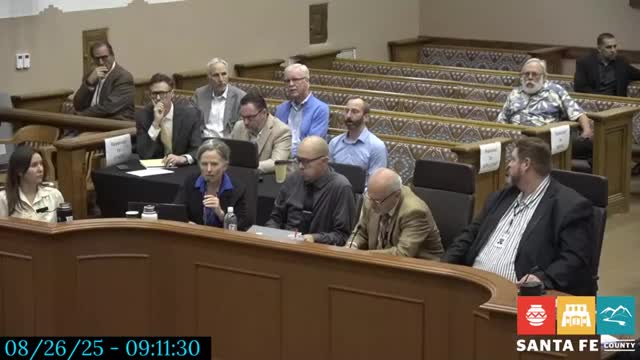
Summary
The Santa Fe County Board of County Commissioners paused action on a conditional-use permit for a large battery energy storage project, asking staff and experts for more details on fire safety planning, fiscal impacts tied to potential industrial revenue bonds and the project's conditions.
Santa Fe County commissioners recessed a special public-hearing session on Aug. 11 and will reconvene at 1:30 p.m. to continue a vote on a conditional-use permit (CUP) for a large battery energy storage system after extended questioning about safety, emergency planning, fiscal effects and code compliance.
County land-use staff opened the hearing with updates requested by the commission, including a summary of comparative studies about sodium-ion and lithium-ion battery systems. "The major takeaway is that in based on the data that's available, the rates of failure are not majority related to the battery cell itself, but rather the all the other components that go into the systems," Land use staff Alexandra said, summarizing materials prepared by sustainability staff Jacqueline Beam and William Donahue.
Why this matters: the project has raised repeated public safety and fiscal questions during multiple hearings and an administrative record that included hundreds of letters. Commissioners pressed staff and public-safety officials for specifics that would inform conditions for approval or a decision to deny the CUP.
What staff told the board - Supply and technology: Staff noted sodium-ion technology is currently limited at scale; a cited pilot is a roughly 5-megawatt demonstration and the sodium technology supply chain was described as immature. Staff also said sodium-ion cells are less energy-dense and would require more physical space than lithium-ion equivalents. - Wages and construction: The applicant reported an average construction wage of about $41 per hour and roughly 200 construction jobs; staff relayed those figures to the commission. - Public correspondence: County staff told the board that the public-exhibit counts on the website include duplicates and multi-letter attachments. A commissioner reported that a liaison verified unduplicated letter counts (opposition and support) and that public-comment attendance was 112 persons in opposition and 40 in favor; staff cautioned the published totals include duplicates.
Fire, hazard and emergency planning Commissioners repeatedly asked when site-specific emergency preparations would be completed. Fire Marshall A.C. Blay told the board that final, site-level training and the operational response plans must be completed before commissioning. "Prior to the commissioning of the facility, all of these would have to be in place," Blay said, adding that commissioning follows construction and his understanding is the project would take about 12 months to build.
Santa Fe County Fire representatives described a multi-layered approach: county adoption of model codes for construction, site-specific hazard-mitigation analysis, and annual tactical "pre-incident" plans maintained by operational crews. The fire department said it conducts annual inspections and maintains operational pre-incident plans that are updated yearly; those plans bring higher-level mitigation analysis down to the tactical level for responding crews.
Codes and hazard planning Staff and public-safety witnesses identified the building and fire standards the county will apply: the 2021 International Fire Code (IFC), the 2021 Wildland-Urban Interface provisions, and NFPA 855 (the standard for energy storage systems, cited in its 2023 edition). Staff also said the county's hazard-mitigation plan as written does not currently reference lithium-ion batteries or large battery energy storage systems; the county is developing a broader Threat and Hazard Identification and Risk Assessment (THIRA) that would address such facilities if they become a local hazard.
Chemicals and environmental risks An applicant representative responding in the hearing said the facility would use a clean-agent suppression product that is technically classified as a PFAS but described by the speaker as one with a short environmental lifetime and low global-warming potential. The applicant representative said he was not aware of other bioaccumulative chemicals beyond some plastics used in module enclosures.
Fiscal questions and industrial revenue bonds Commissioners asked about potential fiscal impacts if the applicant later pursues an industrial revenue bond (IRB). County Manager Schafer explained IRBs are a separate, discretionary legislative process and described them as conduit financing under state law: "industrial revenue bonds, by state statute do not impose any claim upon county revenue or assets... the county is not on the hook for the repayment of the bonds," Schafer said. He added that property-tax effects depend on negotiated terms; exemptions are possible under state law but the county could negotiate payments in lieu of taxes.
Staff review and conditions Land-use staff said the CUP draft has been revised repeatedly during the hearing process; staff reported the conditions related to the project increased through review from 17 at the hearing officer level, to 22 at the first hearing, and to 26 in the current staff recommendation. Staff said additional conditions and third-party reviews (including a fire-hazard reviewer identified in the record as TARFIRE and a noise reviewer, Glorietta Geoscience) informed those requirements. Staff also noted that specific construction items such as a 30,000-gallon water-storage tank were conditioned to be upgraded to 60,000 gallons and that those tanks would be provided by the applicant, not by the county.
Next steps and procedural actions The board recessed to executive session several times to clarify procedural matters and to consult with counsel. After returning to open session the board voted to reconvene at 1:30 p.m. the same day to continue the hearing and complete the vote. Commissioners did not take a final vote on the CUP during the portion of the hearing captured in this transcript.
What the transcript does not show No final decision or formal vote on the CUP appears in the provided transcript excerpt. Staff and board members repeatedly requested follow-up information, and commissioners explicitly asked for more detail on potential IRB structures and fiscal scenarios if such an application were later submitted.
Tapering note The project will return to the commission when it reconvenes; the record identifies multiple outstanding items commissioners asked staff to clarify before a final vote, including fiscal-impact scenarios tied to different IRB negotiations, the public-exhibit counts, and final, site-specific emergency response documentation.