
Santa Fe County approves Rancho Viejo solar and battery project over appeals, 4-1 vote
Get AI-powered insights, summaries, and transcripts
Subscribe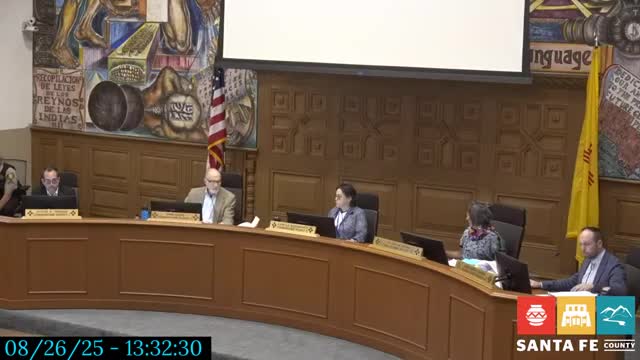
Summary
The Santa Fe County Board of County Commissioners voted 4-1 on Aug. 11 to deny appeals and approve a conditional use permit for the Rancho Viejo solar project, imposing additional safety, decommissioning and land‑use conditions.
The Santa Fe County Board of County Commissioners on Aug. 11 denied appeals and approved a conditional use permit for the Rancho Viejo solar and battery energy storage project, rejecting one commissioner’s call to deny the proposal and adopting additional conditions intended to address safety, decommissioning and land‑use protections.
The vote approving the application by Rancho Viejo Partnership, Rancho Viejo Solar LLC and AES Clean Energy Development LLC was 4‑1. Commissioner Hank Hughes moved to approve; Commissioner Adam Johnson seconded. Commissioners Adam Johnson, Justin Green, Hank Hughes and Chair Camilla Bustamante voted yes; Commissioner Lisa Kokkari Stone voted no.
County staff and the project applicant will be required to meet several additional conditions the board added to staff’s approval, including annual reporting, expanded inspection rights for county staff and a multi‑year decommissioning bond. The board also directed that development rights on roughly 5,700 acres surrounding the project site be irrevocably severed before the conditional use permit site development plan is recorded.
Commissioner Adam Johnson said he would vote in favor, citing the county’s Sustainable Growth Management Plan and county zoning code that allow commercial solar as a conditional use in the rural fringe zone. “This BESS system uses the latest generation technology meeting NFPA 855 and UL 9540‑series standards,” Johnson said, and he noted the county fire department and an independent third‑party consultant had found the application complete and acceptable. Johnson also said the facility would serve “37,000 plus homes” and use minimal water in a water‑scarce region.
Commissioner Lisa Kokkari Stone, who cast the lone no vote, said the county and applicant had not demonstrated the highest standards she expected for a project of this scale. “Until state level regulations are in place and until AES or any developer can present a proposal that truly meets those standards with independent assessments, enforceable safeguards, and appropriate decommissioning and hazard mitigation plans, I believe we cannot move forward with a yes vote today,” Stone said. She raised concerns about battery chemistry and fire risk, proximity to neighborhoods and sensitive areas, potential impacts on vegetation and migratory birds, and the temporary nature of many construction jobs.
The board’s motion included several specific additional conditions described during the meeting: the applicant must use non‑persistent, non‑bioaccumulating, non‑toxic fire‑suppression agents; allow county staff to inspect site compliance with the hazard mitigation plan and conditions of approval with at least three days’ notice; submit an annual report of any abnormal readings from the battery energy storage system to the Santa Fe County Fire Department; and require any power‑purchase or supply agreements to be with a utility that has customers residing in Santa Fe County. The motion also stated that nothing in the approval prevents the board from imposing further conditions in connection with industrial revenue bonds, including restrictions on the sale of power outside New Mexico.
The board modified an existing condition to require a decommissioning bond prior to recordation of the CUP site development plan; the bond must remain in place for the life of the project and be subject to periodic revisions to account for increases in decommissioning costs, no less frequently than every five years. The board also added a restriction barring heavy equipment construction traffic and construction‑related lighting after dark, as set out in the motion.
During the meeting an unnamed county staff member clarified one technical condition: condition 24 requires 60,000 gallons of capacity, not a single 60,000‑gallon above‑ground tank. That capacity, staff said, could be met with one 60,000‑gallon tank or two 30,000‑gallon tanks.
Commissioners who supported approval emphasized comparative risks and regional climate goals. Commissioner Hank Hughes, who made the motion, and Commissioner Justin Green both praised staff’s deliberative process and noted the board added conditions intended to reduce risks and preserve surrounding open space. Hughes said the project would be far less impactful in fire risk than a 332‑home residential development or routine traffic and fuel storage already in the area.
Opponents — as summarized by Commissioner Stone — argued the application relied on older lithium‑ion battery systems that carry fire risks and that the environmental impact assessment identified vegetation, wildlife and cultural resource effects with insufficient mitigation. Stone said the project’s job estimates were overstated in long‑term benefit and urged investigation of alternative approaches, including smaller‑scale distributed solar and safer battery chemistries such as sodium‑ion or lithium iron phosphate.
The board recorded that public testimony and written submissions included hundreds of distinct supporters and opposers. Stone cited “418 unduplicated opposers” and “280 supporters” in written materials, and “112 opposers in oral testimony and 40 supporters in oral testimony,” numbers she said were part of the administrative record.
The board said it will issue written findings of fact and conclusions of law in support of its decision at a later meeting. The motion also directs ongoing county oversight and enforcement; the record shows the county fire department will receive the annual BESS abnormal‑reading reports and county staff will have inspection authority under the conditions adopted by the board.
The conditional use permit approval completes the board’s decision on Case No. 2045200, but several commissioners noted additional county capacity and regulatory issues remain, including staff resources for real‑time monitoring and the need for state‑level standards. Several commissioners said the approval does not foreclose future changes to county code or to the conditions tied to industrial revenue financing.