Get Full Government Meeting Transcripts, Videos, & Alerts Forever!
Get email alerts on the Leachate Pfas Ro Proposal topic
No spam. Unsubscribe anytime.
Marathon County explores regional reverse-osmosis plan to manage PFAS leachate; committee urged to clarify cost-sharing
Summary
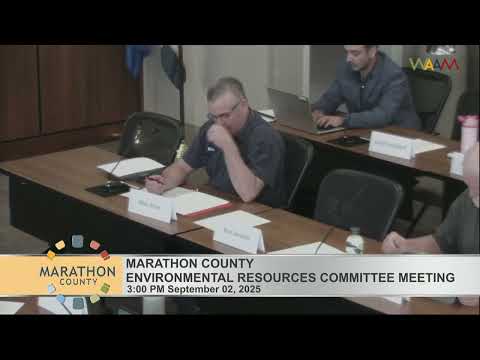
Marathon County officials spent a substantial portion of the Sept. 2 Environmental Resources Committee meeting discussing a proposed regional approach to manage landfill leachate containing PFAS using a reverse osmosis concentration system; the committee did not take formal action but asked staff to clarify contractual and governance options.
Marathon County officials spent a substantial portion of the Sept. 2 Environmental Resources Committee meeting discussing a proposed regional approach to manage landfill leachate containing PFAS using a reverse osmosis (RO) concentration system. The item was presented as an educational discussion; no formal committee action was taken.
Supervisor Tom Robinson (committee chair) and Solid Waste staff outlined a plan in which a RO system would treat incoming leachate, pass roughly 90% of water through membranes, and return a concentrated 10% ‘‘concentrate’’ to the landfill cell. The concentrate would be recirculated into the waste mass where organic material could sequester some PFAS; staff said the approach would reduce leachate volume but would not destroy PFAS. “Separation technologies are really the only thing that are available in the market. These destruction technologies just haven’t been as readily available,” a Solid Waste representative said, describing the approach as a stopgap until destruction technologies mature.
Speakers emphasized that accepting leachate from Portage and Shawano counties or other regional partners would create long-term operational and capital obligations. “If we accepted it in Marathon County from Portage County and they made a payment at the time of bringing it in, that PFAS is continually circulated, and we’re gonna have to treat it through the reverse osmosis during the life of the landfill and for 40 years after that landfill,” Robinson said. Solid Waste staff estimated current transport-and-treatment costs are significant—“right now, it’s a million a year,” they said—and warned that a capital project to install a treatment system could require borrowing; one staff estimate of a preliminary capital need of about $12 million was discussed, with a potential debt-service contribution on the order of $4–5 per ton of waste depending on the financing approach.
Corporation counsel and county staff flagged two primary contractual options: (1) revise or expand the existing intergovernmental agreement with Portage and Shawano counties to explicitly cover RO treatment costs and long-term liabilities and cost sharing; or (2) form a true joint venture (a separate governance entity with its own board) under the county’s joint-venture rules. County corporation counsel noted the board rule’s joint-venture language anticipates an independent governance structure and said staff should evaluate whether the county wants that governance form or prefers a contractual approach that clarifies cost-sharing and indemnification.
County Administrator Lance Leonard said the county should avoid shouldering disproportionate long-term liability for other counties’ waste and urged staff to pursue clarifying conversations with partner counties. “If we’re looking at taking on Marathon County having to take on $12,000,000 debt to implement and then the operational costs on top of that, I think that all has to be put on the table and brought to the other 2 counties to understand,” he said.
Committee members asked technical and policy questions: Supervisor Critt expressed concern that concentrating PFAS and placing the concentrate back into the landfill sounded counterproductive; staff replied there have been studies showing recirculation can reduce volume without immediate breakthrough of PFAS concentrations but that the approach is imperfect and intended as an interim measure. Corporation counsel cautioned that relying on an existing intergovernmental agreement to allocate new treatment costs carries legal risks and recommended early, explicit agreements on capital cost shares, operations and long-term closures and monitoring.
No formal action or vote was taken. Committee members asked staff and corporation counsel to evaluate options and prepare a recommended framework—contractual or joint-venture—addressing capital cost sharing, operational responsibilities and long-term liability, and to continue seeking grant and principal-forgiveness options through state programs. Staff noted a principal-forgiveness application under the environmental loan program was due Oct. 1 and that award decisions are expected in December.