Get Full Government Meeting Transcripts, Videos, & Alerts Forever!
Get email alerts on the Urban Renewal topic
No spam. Unsubscribe anytime.
Feasibility study recommends two urban renewal areas to finance infrastructure; council to consider creating agency
Summary
A consultant told the Umatilla council that forming two urban renewal areas (east and west) would double the city’s redevelopment finance capacity, but would divert future tax increment from other taxing districts and require outreach before the council adopts any plan.
Consultants and city staff presented a financial feasibility study on creating an urban renewal agency and two proposed urban renewal areas for Umatilla, explaining how tax increment financing would work, statutory limits and next steps. Council members did not adopt an urban renewal plan at the meeting but were told the city will present a first-reading ordinance to form an agency at a future meeting and that staff will meet with affected taxing districts.
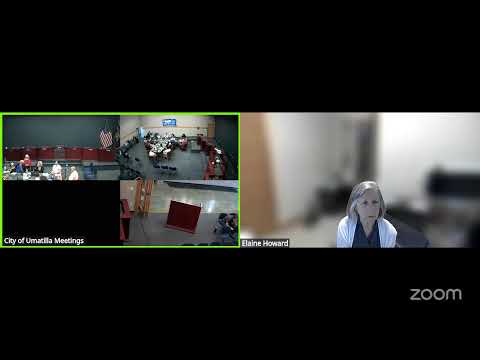
Elaine Howard, a statewide urban renewal consultant, told the council that “urban renewal is not a new tax” and that the financing tool captures increases in property tax revenues within a defined urban renewal boundary (the tax increment) while preserving taxes on the frozen assessed value for all taxing jurisdictions. In Oregon, she said, urban renewal requires a showing of “blight” as defined in state law and is implemented through tax increment financing tied to a plan with a maximum indebtedness (the plan’s spending limit).
Consultants recommended splitting potential urban renewal activity into two separate boundary areas — a west boundary that covers the downtown and core commercial streets and an east boundary that covers portions of the industrial/data-center corridor. Howard explained that state limitations on maximum indebtedness mean each boundary would legally be limited to roughly $78 million in maximum indebtedness; creating two boundaries would give the city combined capacity of approximately $155 million for projects and programs over the life of the plans.
Howard described how increment is allocated. Revenue within the frozen base continues to go to existing taxing jurisdictions; increment — the growth in assessed value after the area is established — goes to the urban renewal agency for projects and debt service. Because of statutory sharing rules and the timing of enterprise-zone abatements, parts of that increment will be shared back with taxing districts at specific thresholds. The consultants’ model estimated revenue sharing would begin at about year eight under the proposed phasing and that the end of enterprise-zone abatement for an identified campus would produce a notable bump in increment around 2035.
City staff and consultants emphasized that federal lands, protected archaeological areas and other constraints influence boundaries. A staff speaker noted much of the federal BLM-managed land north of Fifth Street lies in a mapped historic area (identified in the presentation as 35UM1) and that reconveyance or reuse of federal lands would require additional coordination with tribal, Bureau of Indian Affairs and federal agencies.
The council asked several substantive questions about impacts to schools, fire, and other taxing districts. The meeting included public comment and a written statement read into the record by staff from Heidi Seif, who identified herself as superintendent of the Unitil School District: “As superintendent of the Unitil School District, I cannot share our official stance because we weren't notified of the proposed action, so the board hasn't discussed it,” the statement said. Darla Huxell, a member of the public, also spoke during public comment and said urban renewal “has a direct impact on special districts” and asked that taxing districts be included in early discussions.
Howard and staff described the planned outreach sequence: if the council forms an agency, staff will provide the feasibility study materials, then meet with taxing districts and the county, the planning commission will review plan conformity with the comprehensive plan, and the council would later consider adoption of a plan by ordinance following required notice and hearings. Howard said substantial amendments (for example, increases to boundary acreage or the maximum indebtedness beyond specified limits) require additional approvals and public process.
No formal vote to create an urban renewal plan was taken at the meeting. The council gave direction to staff to bring an ordinance establishing an urban renewal agency for first reading at a future council meeting and to pursue outreach and follow-up steps; the city also voted to extend the meeting to continue the discussion. Consultants said the feasibility results, if the city proceeds, would be used to negotiate intergovernmental agreements with other taxing jurisdictions to mitigate or coordinate impacts where possible.
If the council ultimately adopts urban renewal plans, the study identified eligible projects including street and utility improvements, public infrastructure to serve industrial and commercial sites, brownfield remediation, public open-space improvements and certain acquisition and disposition activities (with statutory limits on the use of eminent domain and expenditure approvals).