Get email alerts on the Land Use Zoning topic
No spam. Unsubscribe anytime.
Umatilla council approves zoning changes to meet state "missing middle" requirement
Summary
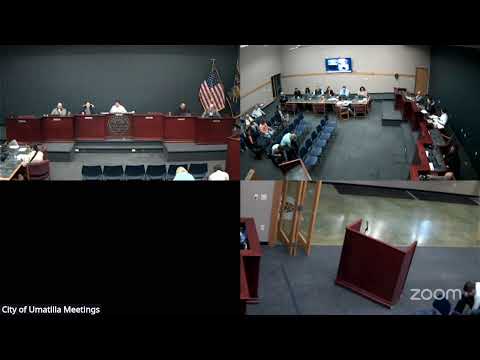
The Umatilla City Council on April 1 approved ZC1-2025, a set of zoning-code amendments that staff said are needed to comply with recent state housing legislation and to encourage higher-density housing downtown.
The Umatilla City Council on April 1 approved ZC1-2025, a set of zoning-code amendments that staff said are needed to comply with recent state housing legislation and to encourage higher-density housing downtown.
Planning staff told the council the changes respond to a state law that, staff said, “requires cities to provide what the state largely referred to as middle” housing and, as a result, “we are now required by state law by 07/01/2025 to amend our zoning code to allow duplexes in any [zone] where we would allow a single family home,” the staff presenter said during the staff report. The package also raises allowable densities in some multi-family and downtown residential zones and updates permitted uses in the downtown commercial zone.
The change most immediately driven by state law removes an outright single-family-only standard in low-density residential zones so duplexes would be permitted where single-family homes are currently allowed. Staff described the second component as an increase in allowable densities in the city’s R-3 and downtown residential zones: staff said the existing R-2 density of about 14 units per acre would be increased to roughly 21 units per acre in R-2, and R-3 and downtown residential densities would be increased from about 26 units per acre to about 36 units per acre to encourage multi-family development downtown. The staff presenter noted that R-3 properties are limited in number in the city and compared the proposed density to neighboring cities in Northeast Oregon.
The third element in the package revises uses allowed in the downtown commercial zone; staff said the intent is to allow some uses, such as modern gas stations with accessory commercial uses, while holding new development to current landscaping and site-design standards so the downtown remains visually attractive. Planning staff told the council the Planning Commission reviewed the proposal and “unanimously voted to recommend all 3 items to city council for approval.”
Councilors asked clarifying questions during the hearing about who would be able to build next to existing single-family homes and whether the state law had removed prior limits such as corner-lot restrictions and population thresholds. In response, staff explained that the newer state law lowered the city-size threshold and removed earlier limits; staff repeated the deadline the city faces to adopt the changes.
After public hearing procedures (staff report, applicant testimony opportunity, public testimony and rebuttal), the council moved to close the record and returned to the regular session to act. A motion to approve ZC1-2025 carried; the council recorded five yes votes and no recorded dissent, and the mayor declared the motion approved.
Why it matters: staff framed the amendments as legally required by the state deadline and as an opportunity to encourage more multi-family development downtown. The changes modify local land-use rules that govern what property owners may build across low-density and downtown residential areas and could affect future development patterns and permit reviews.
What the council did not decide tonight: staff said the package and the RFP-driven build-out choices discussed later in the meeting are policy-level and do not guarantee specific projects — the ordinance establishes rules and densities; subsequent development proposals would follow standard permit and site-review processes.
Votes at the meeting on this item were recorded as a council approval of ZC1-2025 following the staff presentation and public hearing. Planning staff and the Planning Commission were cited as the principal sources for the recommendation; the council did not amend the staff recommendation in the recorded action.
AI generated
The text on this page is AI generated. Summaries, highlights, analysis, and video transcripts are all produced from the original source material.
AI can make mistakes, so if you spot one, and we will fix it for everyone.
Note: the source content is unaltered by us. Any content source we link to, be it a video, an audio recording, or a document, is presented exactly as its publisher released it. That publisher is usually a government body, sometimes an individual official or another organisation.