Get Full Government Meeting Transcripts, Videos, & Alerts Forever!
Get email alerts on the Taskforce Planning Outreach topic
No spam. Unsubscribe anytime.
Task force sets stakeholder briefings, expert panels and site‑visit planning as next steps
Summary
At its Aug. 25 meeting the joint task force on education funding scheduled an Oct. 30 stakeholder meeting in Juneau and a Nov. 17 expert briefing in Anchorage, invited a slate of school administrators, school board and union groups, and asked staff to develop public and educator surveys and site‑visit dates to inform recommendations to the 30th L
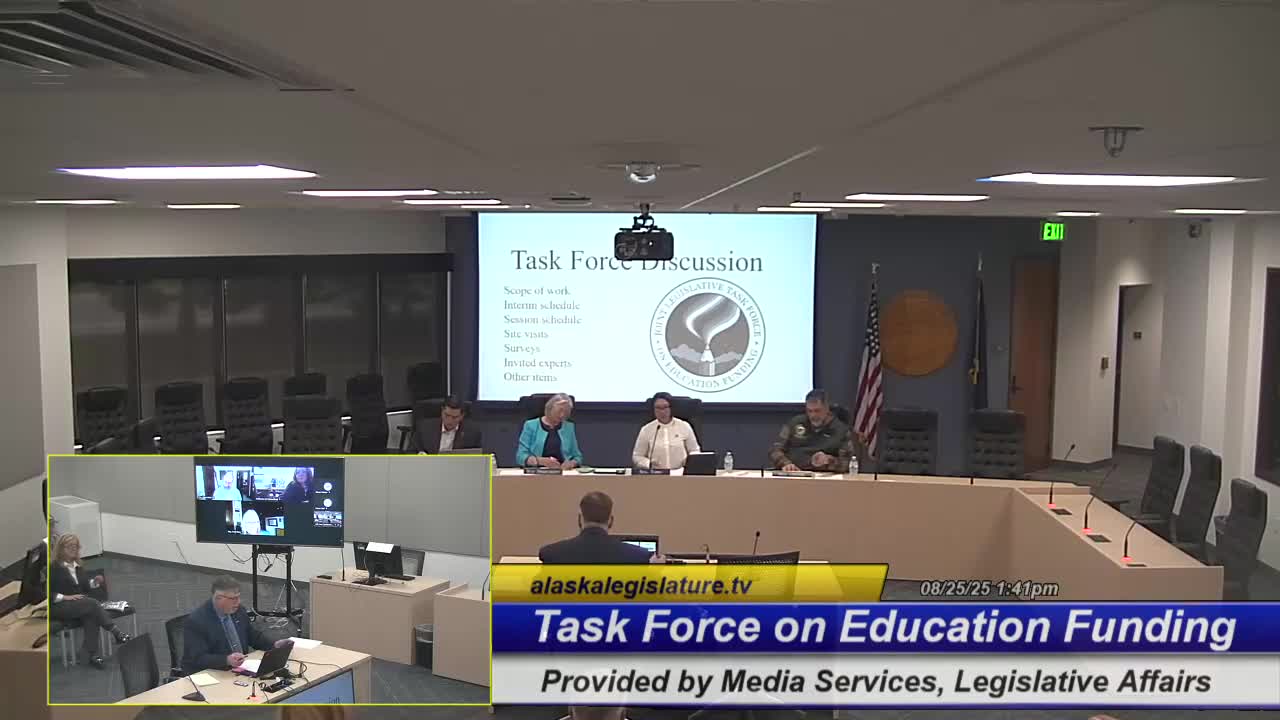
ANCHORAGE — The Joint Legislative Task Force on Education Funding used its Aug. 25 meeting to lay out a public engagement and expert briefing plan, scheduling two near‑term sessions and asking staff to organize surveys and site visits to gather on‑the‑ground evidence for the task force’s January 2027 recommendations.
The task force set an Oct. 30 stakeholder meeting in Juneau to hear from the Alaska Department of Education and Early Development, the Alaska Council of School Administrators, the Association of Alaska School Boards, the Alaska Municipal League and the NEA, among others. The group scheduled a Nov. 17 session in Anchorage to begin technical work on the foundation formula, including presentations from the University of Alaska’s Institute of Social and Economic Research and national funding adequacy experts the task force described in its packet (Larry Pikus of Pikus Soden and APA Consulting’s Justin Silverstein).
Why it matters: The task force’s charge is to recommend changes to state education funding and accountability for the 30th Legislature. The schedule and outreach plan determine whose experiences and data will inform those recommendations.
Public engagement and surveys: Cochair Representative Rebecca Henschute told members the task force would launch several survey tracks: (1) a broad public survey to help prioritize issues listed in HB 57; (2) a boots‑on‑the‑ground survey of educators and school support staff; and (3) a targeted survey for elected school board members. Members asked staff to design the surveys with drop‑down and open‑ended elements to capture priorities such as accountability metrics, teacher recruitment and retention, attendance policy and facility maintenance.
Site visits and recommended communities: Members suggested a combination of urban and remote site visits to capture the state’s diversity of school models. Specific recommendations from members included visiting Southeast Alaska sites, Galena (which has a residential school and a large correspondence population), the Anchorage School District, Prince of Wales, Skagway (noted as a high‑performing single‑site district), and CTE programs. Members discussed whether to have the full task force visit a single site or use a divide‑and‑conquer approach; staff were asked to circulate available dates and coordinate logistics to minimize travel conflicts and weather risk.
Stakeholders and experts invited: Staff said invitations had gone to DEED, the Alaska Council of School Administrators, the Association of Alaska School Boards, the Alaska Municipal League, NEA Alaska, and several long‑service education leaders including former DEED commissioner and UAF chancellor Meredith “Marshall” Lind (name as recorded in meeting materials). Mike Mason, task force staff, asked members for additional suggested invitees and said staff would follow up on travel pre‑authorization and scheduling.
How to comment: The task force will not take public testimony at every meeting; the group asked the public to submit written comments to edfundtaskforce@akleg.gov and said more engagement opportunities will follow during site visits and when draft recommendations are prepared.
Ending: Members emphasized collecting input from “boots on the ground” educators and school boards and said the Oct. 30 and Nov. 17 meetings will be the first formal opportunities for stakeholder and technical input.