
DNR proposes 3% royalty cut to extend Nicolai Creek gas unit and spur drilling, says itis in stateinterest
Get AI-powered insights, summaries, and transcripts
Subscribe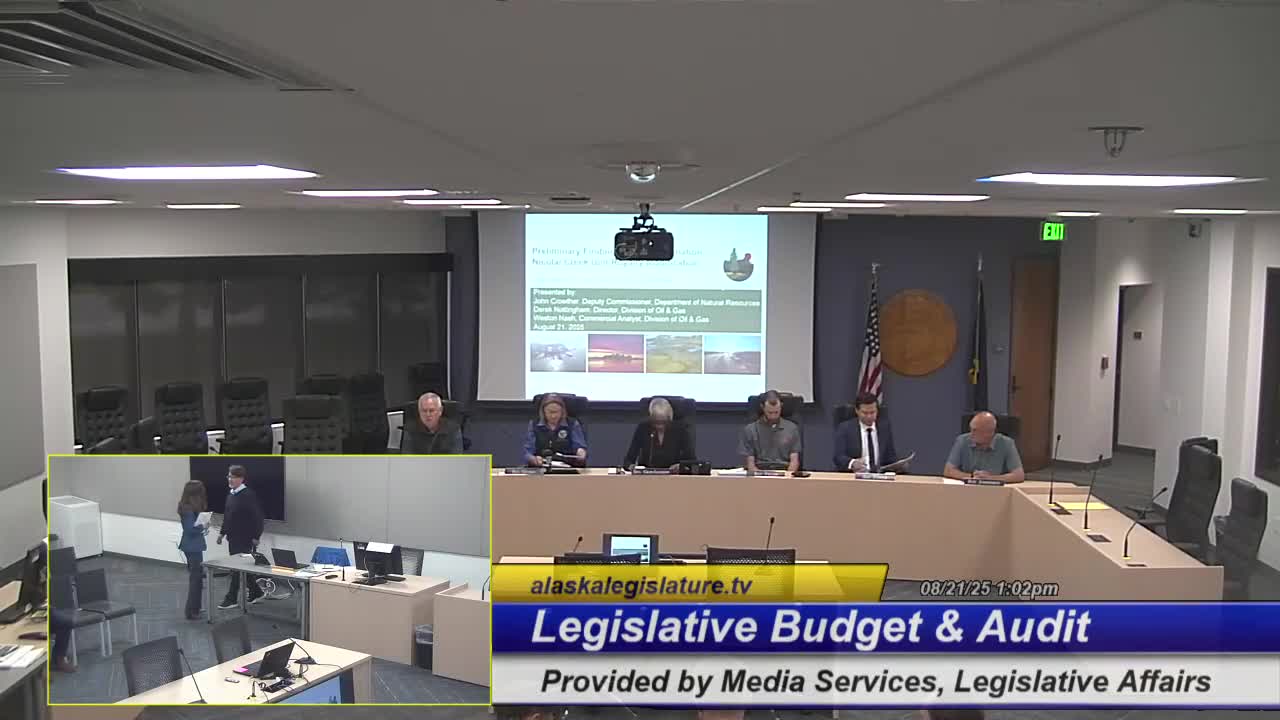
Summary
The Alaska Department of Natural Resources presented a preliminary best-interest finding to the Legislative Budget and Audit Committee on Aug. 21 proposing a temporary reduction of the Nicolai Creek unit royalty to 3% until a cumulative gross-revenue target is met, aiming to extend field life and encourage development drilling in Cook Inlet.
The Department of Natural Resources on Aug. 21 told the Legislative Budget and Audit Committee it is proposing a temporary reduction of the Nicolai Creek unit royalty to 3% beginning Sept. 1, 2024, until a cumulative gross-revenue target is reached, a move the department says would extend the unitfield life and increase the likelihood of development drilling that would add gas to the Cook Inlet market.
Why it matters: Cook Inlet natural gas supplies Southcentral Alaska, and DNR officials told legislators that smaller gas volumes from aging fields can affect in-region deliverability and prices. The department framed the royalty modification as a tradeoff between near-term royalty revenue and longer-term increases in gas volumes, jobs and overall state receipts if new drilling occurs.
The departmentpresented the committee with modeling results and a preliminary best-interest finding published Aug. 5 that opened a public comment period through Sept. 5. Weston Nash, commercial analyst with DNRDivision of Oil and Gas, led the presentation and said the proposal combines a low temporary royalty rate with a gross-revenue trigger so the reduced rate ends automatically when the revenue threshold is met. Nash told the committee, "Granting this royalty modification is in the best interest of the state."
Key facts presented to the committee: - Proposal and mechanism: DNR proposed a 3% royalty rate for the Nicolai Creek unit starting Sept. 1, 2024, until a cumulative gross-revenue target of $25,000,000 is reached, at which point the royalty would revert to the statutory 12.5% in the month the target is attained. DNR said the arrangement would be subject to royalty audit and to termination if criteria are not met. - Statutory framework: Presenters cited AS 38.05.180(j)(1)(B) (authority to grant royalty modifications to prolong economic field life) and related subsections allowing reestablishment of production from previously producing zones; DNR noted statute requires a "clear and convincing" showing that a modification is in the state's best interest and that the mechanism consider price and other relevant factors. - Field economics without modification: DNR said its modeling (about 50 scenarios reviewed, 10 summarized for the committee) shows Nicolai Creek would reach an economic end of field life in September 2026 if no additional drilling or royalty relief occurs. DNR reported production to date through June 30 of about 60 million cubic feet from two producing wells and that a third well was recently added. - Effects of the modification without new drilling: Under a model where no new development occurs, the department said the royalty modification would extend the field life about one year (to roughly September 2027) and add roughly 79million cubic feet of additional gas to the system; state royalty revenue would decline for that period while modest increases in production tax and property tax could occur. - Effects with development drilling: DNR emphasized the largest benefits occur if the royalty change helps secure funding for a two- or three-well development program. In DNRmodels where development drilling proceeds, the department estimated an additional 1.2to 2.7 billion cubic feet (BCF) of gas over multiple years and an increase in cumulative state receipts ranging from several hundred thousand dollars up to roughly $900,000 in the modeled "expected" scenario; DNR said the low royalty rate produces the highest likelihood that drilling will proceed. - Tradeoffs and controls: DNR staff said the proposed mechanism aims to avoid indefinite revenue loss by using a gross-revenue trigger, retaining audit rights, and prohibiting automatic assignment of the modification to a new owner without a new best-interest finding. The department also said overrides (private overriding royalty interests) exist on leases and are contractual matters among parties, not under state control.
Committee process and next steps: The presentation was informational; the committee did not act on the proposal. DNRpublished a preliminary best-interest finding Aug. 5 and opened a statutory public comment period that the department told the committee closes Sept. 5; the commissioner will consider comments before a final decision. Committee members asked technical and policy questions about the choice of a 3% minimum, the likelihood that drilling would occur at different royalty rates, precedent for future Cook Inlet decisions and how DNR balances short-term revenue with regional gas supply. John Crother, deputy commissioner, and Weston Nash answered those questions on behalf of DNR.
Quotes from the record: "Granting this royalty modification is in the best interest of the state," Weston Nash, commercial analyst, Division of Oil and Gas, Department of Natural Resources.
Ending note: DNR advised the departmentwebsite and the state's public notice system host the preliminary finding; the agency asked interested parties to submit comments by the Sept. 5 deadline. The committee closed the Aug. 21 hearing after roughly 90 minutes; no formal legislative action was taken at this meeting.