
Staff presents parking-analysis and recommends zoning-code updates to address growth and micromobility
Get AI-powered insights, summaries, and transcripts
Subscribe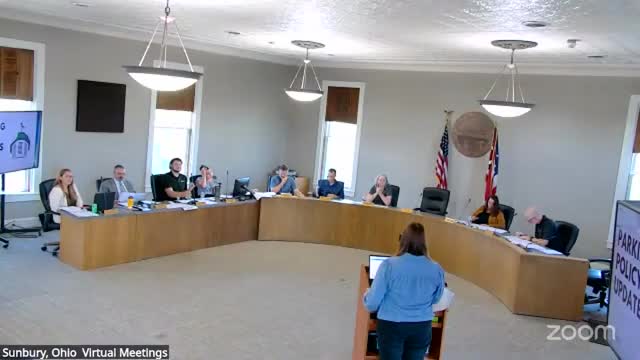
Summary
Planning staff presented a citywide parking analysis, recommending ordinance changes including removing minimum parking requirements, defining recreational and commercial vehicles, and conducting a parking utilization study.
City planning staff presented a parking analysis to the Planning and Zoning Commission, mapping current no‑parking zones and public lots, identifying discrepancies between the ordinance and on‑the‑ground parking, and recommending changes for the municipal zoning code update.
Planner Katie Oberlin said she used the city ordinance (Chapter 351) and GIS to map where parking is allowed and where it exists in practice, including Town Square lots and several no‑parking designations recorded in the code. She recommended, among other items, “removing the minimum parking requirements,” encouraging shared parking, and changing minimums to maximums to avoid oversupply. She also proposed clearer definitions for recreational vehicles and commercial vehicles and stronger micromobility (scooters, e‑bikes) parking guidance so sidewalks remain clear.
Staff noted existing code lists specific no‑parking streets but does not map all existing parking spaces; one example is a section of West Granville Street that is technically a no‑parking area though spaces exist. Staff recommended a staged implementation: conduct a parking utilization study to quantify supply and demand; update ordinance language (including school‑adjacent parking rules and street‑width thresholds that govern one‑side parking); improve signage and wayfinding; and, if warranted, define the role and powers of a transportation coordinator.
Commissioners raised practical questions about golf carts, private shared parking arrangements and enforcement. Staff said golf carts are not specifically addressed in the ordinance and will be reviewed; she offered to include golf‑cart policy in the zoning code update. Staff also noted the zoning code rewrite is on a timeline tied to grant funding and must be substantially advanced by 2026.
No formal action was taken; the presentation will inform the city’s zoning code update and future commission review. Staff asked commissioners and community members to submit comments for inclusion in the zoning‑code process.