
City attorney outlines 2025 Texas legislation that will change local rules for zoning, development and public records
Get AI-powered insights, summaries, and transcripts
Subscribe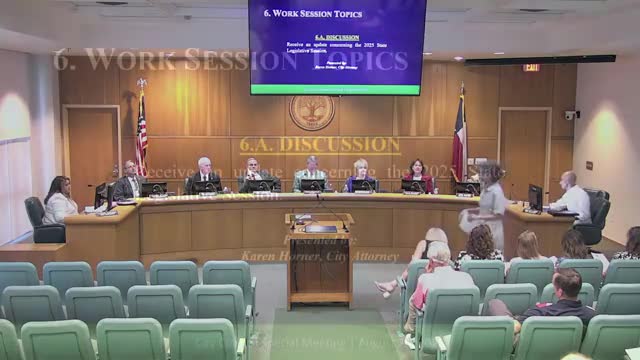
Summary
City Attorney Karen Horner briefed the council on dozens of bills from the 2025 Texas legislative sessions that she said will affect municipal authority over zoning notices, home‑based businesses, manufactured homes, impact fees, open‑meetings posting and other topics.
City Attorney Karen Horner gave the Friendswood City Council a wide‑ranging briefing Aug. 25 on bills passed in the 2025 Texas legislative sessions she said will affect city authority over zoning, development, public safety and municipal operations. Horner told the council the legislature introduced substantially more bills affecting cities this session and that roughly 20% of the bills that passed addressed municipal matters. She summarized measures that, in her view, clarified zoning‑notice procedures, limited local regulation of no‑impact home‑based businesses, established new rules for manufactured homes and single‑family construction and changed procedures for impact‑fee advisory committees. Key items she cited included House Bill 24, which she said clarified notice requirements for citywide zoning changes and required posting of designated‑site signs for zoning changes; bills limiting municipal authority over no‑impact home‑based businesses while preserving health and safety regulation; a bill that affects notice and filing requirements for plats; and measures about mobile food vendors and agricultural operations adjacent to rights‑of‑way. Horner warned that some bills reduce municipal discretion in specified areas: she cited legislation that, in certain circumstances, preempts city regulation of agricultural facilities and manufactured‑home siting, and another that limits local impact‑fee procedures and requires changes to the composition and placement of capital improvements advisory committees (she said the city will have to move that committee out of planning and zoning). She also summarized bills that affect emergency‑operations requirements, posting of public information, open‑meetings notice timelines and requirements for cybersecurity, training and public‑information responses. On open meetings, Horner noted a new requirement to post meetings earlier (three business days before the meeting, which she said translates to four business days on the city calendar) and a new requirement to include a taxpayer‑impact statement with agendas. On public‑information requests, she said the law now requires more specific written reasons when the city withholds records and will require additional training if the attorney general finds noncompliance. Horner said some provisions are population‑bracketed and therefore not immediately applicable to Friendswood, but several are directly applicable and will require ordinance, policy or administrative updates. She told the council staff will return with necessary changes and that the presentation was intended as a high‑level overview; she invited questions and follow‑up from council members. No formal council action was taken during the presentation.