
Family Resource Network launches early learning community pilot, seeks county input and survey responses
Get AI-powered insights, summaries, and transcripts
Subscribe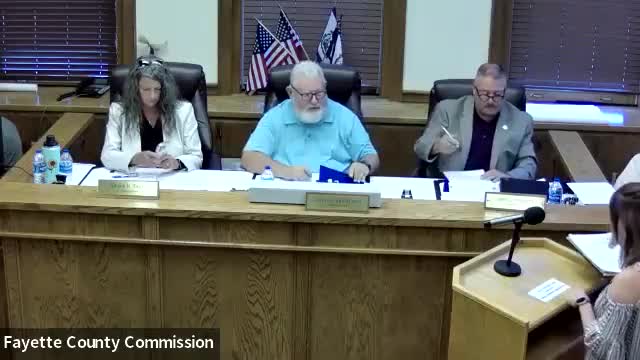
Summary
Fayette County Family Resource Network described a $25,000 grant and an Early Learning Nation assessment the county is using to map strengths and gaps for children prenatal to age 8; organizers asked commissioners to complete or promote a national and local parent assessment and said they have 124 parent responses so far.
Diane Paulson, executive director of the Fayette County Family Resource Network, updated commissioners on Sept. 3 about a new local initiative, the Early Learning Community, driven by a national model and funded in year one by a $25,000 grant housed at the Family Resource Network.
Paulson said the initiative uses the Early Learning Nation assessment framework, which evaluates communities across four building blocks — community commitment, services, neighborhoods and policies — for children prenatal to age 8. Fayette County was one of six rural communities selected for the national organization’s first rural cohort.
Paulson described two local survey tools: the national online assessment managed by Early Learning Nation (which requires account creation and an email confirmation) and a simplified local “parent community assessment” (paper or Google Form) the FRN created for parents who lack internet or who prefer simpler language. The local parent survey offers a $25 gift card incentive for completed responses.
Paulson said 124 parent surveys have been returned so far. She flagged the questions with the highest “no” response rates: whether the county makes young children and families a priority (community commitment); availability of child care for ages 0–36 months and child care for children with special needs (services); whether respondents interact with neighbors (neighborhoods); and whether local leaders consider how decisions affect families (policies). She reported that 73% of respondents said they feel welcome to voice opinions to the County Commission.
Paulson said the project’s first year is data collection; next year (2025) the FRN expects to use assessment results and community conversations to develop an action plan to address gaps and pursue funding. She said the FRN is holding outreach events, has presented to the county board of education (presentation scheduled Sept. 30) and will host more community conversations before the 2025 action plan. Paulson asked that commissioners complete the national assessment or distribute the parent assessment and noted that the grant’s incentive and timeline make a 2025 completion target appropriate.
Commissioners asked about outreach to families served by Starting Point centers, the representativeness of the sample, and how an action plan would translate into services; Paulson said the first year focuses on building the evidence base and that service delivery would follow if an action plan identifies fundable gaps.
No formal county funding request was made at the meeting; the FRN requested help promoting the assessments and emphasized the $25,000 grant supports the first year of data collection and planning.