
Winston-Salem/Forsyth board approves staff cuts after state audit finds long-running financial problems; parents, teachers protest EC reductions
Get AI-powered insights, summaries, and transcripts
Subscribe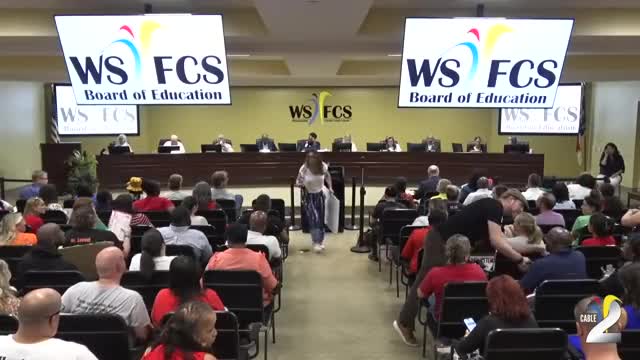
Summary
The school board voted 6–3 to implement a reduction-in-force plan tied to an auditor-identified budget shortfall. Speakers at a packed public-comment period urged the board to spare Exceptional Children staff; administrators said the cuts are needed to balance the 2025–26 budget.
The Winston-Salem/Forsyth County Schools Board of Education voted 6–3 Aug. 19 to approve a reduction-in-force proposal intended to close an immediate budget shortfall identified in an investigatory audit by the North Carolina Office of the State Auditor. The board also approved a superintendent search firm and a fiscal-year 2026 budget amendment during the meeting.
The vote followed a presentation of the auditor’s findings and a three-hour public-comment period in which dozens of parents, teachers and school leaders urged the board to avoid cuts to Exceptional Children (EC) staff and assistant principals. Interim Superintendent Caddy Moore told the board the audit found repeated weaknesses dating back to 2017 and that the district is “in a deep financial hole.” Moore said the combination of a state allotment reduction, lower federal carryover and prior-year fund-balance use creates roughly the minimum $18 million in reductions the district must address before the board can adopt a balanced 2025–26 budget.
Why it matters: The district’s plan would change the terms of employment for many positions, eliminate some school- and central-office roles and impose a tiered furlough for central-office employees, while leaving key EC itinerant services and related therapists (speech, physical and occupational) out of the proposed cuts. Public commenters said reducing EC positions threatens legal compliance under IDEA and student services that many families rely on.
Administrators stressed the changes are tied to audit recommendations and to correcting long-standing budget practices. Moore said the auditor’s team found seven formal findings and an additional assessment, including failure to align staffing with declining enrollment, use of temporary pandemic funds for recurring salaries, and inadequate budget-to-actual reconciliation. "We agree with the auditor's findings and are acting to fix and address the problems through the recommendations and the findings that they have made," Moore said during the discussion.
Public reaction and evidence: More than 80 people addressed the board in somber, often emotional one-minute statements. EC teachers and parents repeatedly warned of lost services and legal risk. "We are slashing EC resources. We set our students up for academic regression they may never fully overcome," said Tiffany Smith, identified in public comment as an EC teacher. Jill Evans, an EC teacher, invoked federal special-education law and warned that parents will file due-process complaints if services are reduced: "Public law 94-142...stated all students get a free and appropriate education," she said.
Several principals and school leaders also urged restraint. Colin Tribby, principal and president of the Forsyth Principals Association, said layoffs could make schools less safe and make it harder to improve student achievement: "The people whose lives are being most directly impacted by the cuts had nothing to do with how we got here," Tribby said.
What the board approved: The administration’s recommended package (proposal B, as presented) calls for elimination of 343.65 positions, reduction in term of employment for 288.94 positions in fiscal 2026 (and 26 positions in fiscal 2027), and a tiered furlough for central-office employees. The recommendation included a modification allowing 51 licensed administrators or district-licensed employees to be demoted via RIF into licensed teacher roles for which they are certified, which lowered projected savings by about $1 million compared with an earlier version but preserved the overall reduction target when combined with other changes the district plans to pursue.
Moore and staff explained implementation steps: affected employees will receive notice and meetings beginning immediately if the board approved the plan; some notifications and placements depend on September ADM (average daily membership) reconciliation. Human Resources presented current EC staffing snapshots: 350.4 EC teachers and 442 teacher-assistants districtwide (first-day snapshot), and the administration’s proposal would eliminate about 61.9 EC teaching positions and 97 EC teacher-assistant positions under the recommended cuts.
Legal and procedural context: The board and district repeatedly cited federal IDEA obligations, state allotment rules that fund EC positions at up to 13% of enrollment, and district policy that governs reductions in force (policy 41-19.3). Moore also noted the state auditor has requested the State Board of Education and the Local Government Commission consider an independent audit of internal controls under statutory authority.
Other actions: The board selected Summit Search as the superintendent-search firm (motion passed with a 5–3 vote and one recusal for conflict of interest) and approved a FY26 budget amendment/transfer unanimously.
What’s next: Staff said they will implement the RIF timeline if the board’s vote stood: notifications and HR meetings will follow, schools will reconcile ADM on day 10 and HR will attempt to place any certificated employees into available openings where possible. Moore warned that, without reductions or outside funding, the district would begin to run cash shortages as early as September and face an inability to pay some obligations by October. Several board members urged further discussions with county and state officials and asked the superintendent to develop alternatives that could include adjustments to local salary supplements or other local sources, while cautioning that those changes would carry policy and political consequences.
Ending note: The meeting underscored a familiar tension — the board and administration framing the actions as fiscal emergency responses to auditor-identified systemic problems, and families and educators arguing that cuts to EC services and school-based staff will harm the district’s most vulnerable students and invite legal challenges. The first public-facing audit follow-up and the district’s proposed corrective actions will be monitored by the auditor’s office and reported back to the board in coming months.