
Winston‑Salem/Forsyth schools report gains in state accountability; several schools cite aligned planning and coaching
Get AI-powered insights, summaries, and transcripts
Subscribe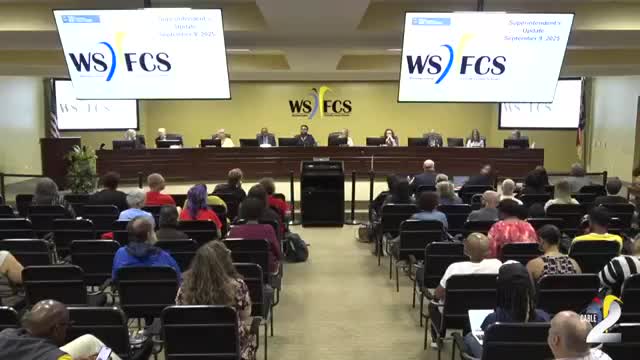
Summary
District leaders presented North Carolina Every Student Succeeds Act accountability results showing overall growth since the pandemic, crediting collaborative planning, data‑driven instruction and school coaching models for gains at several elementary, middle and high schools.
Winston‑Salem/Forsyth County Schools on Thursday highlighted districtwide gains in state accountability results and credited school‑level changes such as collaborative planning, professional learning teams and coaching for recent improvements. Superintendent Moore and district accountability staff said many schools showed year‑over‑year growth in reading and math and several formerly low‑performing schools have come off the state list.
The district’s chief of staff for strategic planning, Dr. Effie McMillan, said the state Department of Public Instruction released the 2024–25 accountability data and that the measures provide a one‑year snapshot of achievement and growth under the Every Student Succeeds Act. Assistant Superintendent Andy Craft told the board that 45 schools exceeded expected growth, 14 improved their performance composite and seven schools left the low‑performing list. Atkins and Reagan high schools were reported to be in the top 1% statewide for growth.
Forest Park Elementary Principal Dr. Deborah Gladstone, Walkertown Middle Principal Monica Comer and Kennedy High Principal Dr. Alfreda Smith described school practices they said underpinned local gains: 90‑minute collaborative planning sessions, weekly professional learning team meetings focused on standards and short‑cycle formative assessment, targeted use of instructional assistants for small‑group literacy and math work, and refreshed PBIS expectations to raise instructional time and engagement. Craft and the principals said those systems support faster data‑driven responses to students who are not meeting standards.
The board and staff noted persistent subgroup gaps. Craft and Superintendent Moore emphasized that although district proficiency remains below pre‑pandemic levels in aggregate, many schools improved and that closing racial and subgroup achievement gaps will require “more than a year’s worth of growth” in a single year. Board members requested comparative data showing how the district’s distribution of school‑grade letters and growth compares with peer urban districts and asked for more study of the “opportunity culture” model that several high‑growth schools have used.
District staff said the science test was renormed last year and that science scores are not comparable to past years. Staff also reported increases in career and technical education (CTE) participation and highlighted growth in the district’s four‑year cohort graduation rate, which Craft reported as 86 percent. Board members and district staff agreed to follow up with more cross‑district comparisons, deeper study of fidelity of implementation in high‑growth schools, and targeted plans to accelerate gains for historically lower‑performing subgroups.
The board discussion included requests for supplemental materials and for an analysis of whether specific program models (for example, opportunity culture) are replicable across schools, and district staff agreed to provide additional data in coming weeks.