
City officials outline 295‑acre Addison Groveport development; school board members say district was not consulted
Get AI-powered insights, summaries, and transcripts
Subscribe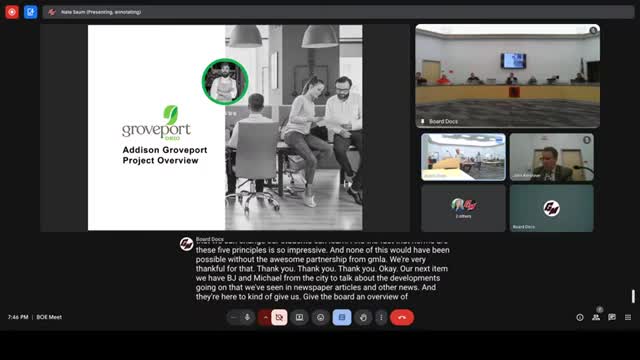
Summary
City of Groveport officials told the Groveport Madison School Board on Tuesday that a 295‑acre site annexed into the city is planned as a phased, mixed‑use development that will require tens of millions in infrastructure investment; board members said the district learned late of the project and asked for data on likely student impacts.
City of Groveport officials gave the Groveport Madison School Board an overview of a proposed 295‑acre development called Addison Groveport and said the project will require substantial public‑infrastructure work and significant phasing. Board members pressed city staff for data on how many new students the development could bring and said the district was not directly consulted before the project advanced.
The city presentation said the property — described by city staff as ‘‘Addison Groveport’s property’’ — will be a mix of uses and is planned to be built in phases over about 10 years. Michael Lodris, development director for the City of Groveport, told the board, ‘‘This is Addison Groveport’s property. It’s 295 acres.’’ Lodris and a second city official called attention to constraints on the site, including flood‑plain areas, and to the infrastructure cost the developer has estimated. ‘‘They have to invest around $60,000,000 in infrastructure to to see this to full completion,’’ Lodris said, calling out an approximate $17,000,000 cost to extend sanitary sewer under U.S. 33 as a discrete early expense.
Why it matters: Board members said the scale of homes and townhomes planned south of Sims Road could add students to district schools and would require long‑range facility and transportation planning. Board member Miss Gray told city officials, ‘‘I would just like to say then I’m kind of disappointed in the city that they did not come to the board at all to have our discussions with us before this development happened. This really impacts our school district and the number of students that we have.’’
Details: City staff described five subareas within the site, with a mix of multifamily, single‑family and townhome products; they said the developer expects single‑family homes in some subareas to average about $415,000 and three‑bedroom townhomes about $350,000. Lodris said phase‑one vertical construction on the southern part of the site could begin in mid‑2027, but that market timing will affect multifamily and commercial components north of Sims Road. City presenters also emphasized transportation dependencies: the developer and the city are discussing a full interchange at Bixby Road and an aligned parallel roadway to U.S. 33 that city staff say will be necessary before some northern parcels can be developed.
City and district exchange on consultation and responsibilities: Board members asked whether the city had studied the likely number of new students and whether the city planned to contribute funding for additional classroom, transportation or other school facilities. BJ, a city official, answered the latter question directly: ‘‘City is unable to use public funds towards that sort of use.’’ The city told the board it had engaged district administrative leaders at some points — via letters from the applicant and presentations to the Community Improvement Corporation — but that it had not briefed the board directly. ‘‘We did not reach out to the board directly,’’ a city representative said. The board members said that missed opportunity complicated the district’s ability to plan for rapid growth, including decisions about capital bonds and future schools.
Funding, timeline and constraints: City staff said much of the initial site work will be private development expense but that the scale requires utility upsizing with extra capacity the city requested. They also said significant earthwork and flood‑plain mitigation will be required; the developer estimated major dirt and compaction costs and told the board those site costs alone would run into the millions. The city flagged that some elements north of Sims Road are market‑dependent and that construction of the Vixby/Bixby Road interchange and parallel roadway would be a major inflection point for further buildout.
Board follow‑up and next steps: Board members asked the city to provide the slide deck and asked that future, earlier briefings occur so the district can include any large pending developments in facility and bond planning. Superintendent and city staff suggested better joint planning going forward: the city noted its intention to upsize utilities to allow for additional nearby development and recommended the district’s master facilities planning process incorporate the new land‑use information. Several board members said they expect to work with the superintendent and city leaders to get more precise enrollment and infrastructure impact estimates.
Ending: City staff closed by urging continued dialogue and saying the project is one of several regional developments that city leaders view as essential to expanding Groveport’s tax base. The board requested the formal slide presentation be emailed to district staff and said it will pursue follow‑up information about projected student generation and transportation impacts.