
State update: new school screening law, transit funding stalls, Peotone RFQ extended
Get AI-powered insights, summaries, and transcripts
Subscribe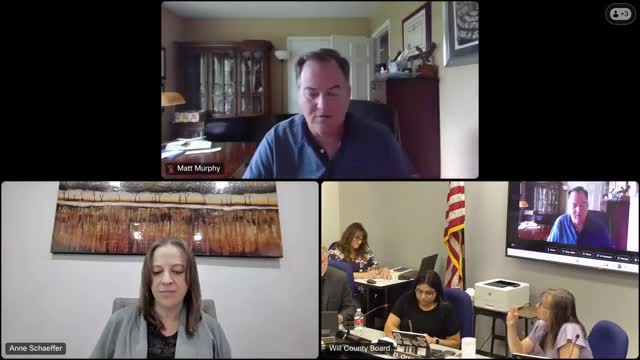
Summary
Max Strategies told Will County's legislative committee that two bills the firm tracked were signed into law, that Peotone Airport procurement remains in RFQ/RFP stages, and that a new school mental-health screening law requires districts to offer screenings while the state finalizes tools and funding.
Max Strategies gave the Will County Legislative Committee a state-level briefing that covered recently signed bills, the status of Peotone Airport procurement, transit-funding proposals, and a newly enacted law on school mental-health screenings.
Two bills signed: Matt from Max Strategies highlighted House Bill 663 and House Bill 1364, describing them as measures the firm had tracked during the spring session. "Those were both signed into law by the governor this month," he said.
Peotone Airport procurement: The consultants said the Peotone Airport process remains in a request-for-qualifications (RFQ/RFP) phase and appears extended into 2026. "They are still in the request-for-questions, RFQ standpoint; it is my understanding that that is being extended out into the '26," Matt said, but he added there is not yet an imminent development decision.
Transit funding and the RTA: The firm summarized efforts to address a fiscal cliff for transit agencies. A Senate bill considered a real-estate-transfer-tax increase for collar counties (bringing suburban rates up to Chicago levels) and a statewide delivery fee for online deliveries, but the House did not take up that version. Max Strategies said the legislature has transferred funds within the RTA system to ease immediate pressure on the CTA, and that lawmakers were unlikely to resolve the issue before the veto session in October.
Mental-health screenings in schools: Anne from Max Strategies described a signed bill (referred to in committee discussion as "bill 1560") that requires school districts to offer mental-health screenings. "This bill that passed, basically simply said that school districts need to offer mental health screenings and that's it," Anne said. The law requires the state to procure a screening instrument and pay for it; school districts are not required to implement screenings until a statewide contract and tool are in place. The State Board of Education must resolve implementation questions and issue a report by Sept. 1, 2026, and the law does not prescribe specific follow-up actions for districts after screenings.
Committee discussion included county members raising concerns about how screenings would be funded, who would administer them, confidentiality and data-sharing protections, and the need for resources to follow up on screening results. Member Julie Berkowitz described delays in getting children onto Individualized Education Programs and asked how the county could provide input; Anne said Max Strategies could convey local experiences and recommendations to lawmakers and the governor's initiative team.
No committee action was taken; Max Strategies and county staff agreed to continue monitoring these items and to pass member concerns to legislative contacts for follow-up.