
Bel Air commissioners debate limits on long-term leases of town parking for private development
Get AI-powered insights, summaries, and transcripts
Subscribe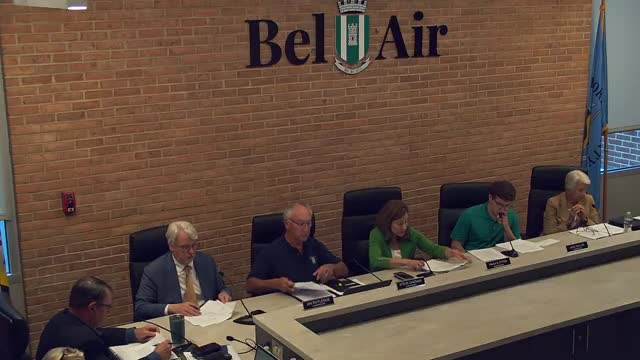
Summary
The board discussed draft revisions to the town development code to require Board of Commissioners review of multi-year leases of town parking and to limit long-term commitments of public parking spaces for private residential projects.
Bel Air commissioners discussed proposed changes on Sept. 9 to town development code Chapter 165 that would tighten how the town allocates municipal parking for private uses, including long-term leases proposed for residential developments.
The draft language circulated to commissioners would require any renewable lease of town parking that exceeds one year to be approved by the Board of Town Commissioners at a public hearing. The draft would also remove language that implicitly allowed some nonresidential allocations without board approval and would make the board the authorizing body for multi-year commitments of public parking assets.
Proponents of the change said the board should retain authority to approve long-term allocations of town resources and avoid multi-decade commitments of public parking to private projects. One commissioner said the town should avoid subsidizing private development by dedicating town parking for long terms and recommended establishing one- to three‑year administrative leases for routine employee or tenant parking while reserving longer terms for board review.
Other commissioners and staff urged caution, noting that the town has very few long‑term lease arrangements and that tightening rules could prompt applicants to pursue variances under state law instead. Legal and planning staff advised that the board’s review of lease requests would be an administrative, evidence‑based process distinct from legislative zoning decisions: the board would evaluate solvency, enforcement, and factual criteria specific to a lease request rather than substitute design judgments that belong to the planning commission.
Staff framed the proposal as a starting point for discussion; draft text retains practical factors such as a 500‑foot locality requirement and impracticality standards used historically but moves decisions about longer-term lease approvals to the full board. Commissioners asked staff to circulate revised language and to run examples against recent projects so the board can see how the change would apply in practice.
Ending: The board did not adopt an ordinance on Sept. 9; commissioners requested that staff circulate a revised draft and background data on prior parking leases for further review.