
Supervisors vote to pursue legal options after USDA demand for SNAP applicant data
Get AI-powered insights, summaries, and transcripts
Subscribe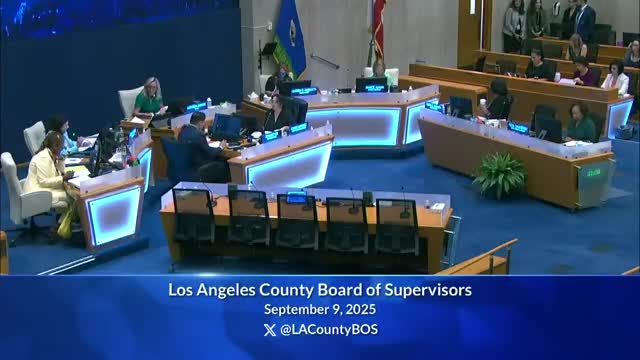
Summary
The Los Angeles County Board of Supervisors voted Sept. 9 to explore legal remedies and potentially join California's lawsuit after the U.S. Department of Agriculture requested five years of Supplemental Nutrition Assistance Program application records, a move county officials said risks deterring eligible residents from enrolling.
The Los Angeles County Board of Supervisors voted 5-0 Sept. 9 to direct county counsel and staff to explore legal remedies and to coordinate with the state after the U.S. Department of Agriculture requested five years of SNAP (CalFresh) applicant records.
Why it matters: USDA's request for names, dates of birth, Social Security numbers, mailing addresses and shopping history, county officials said, could have a chilling effect on mixed-status households and other eligible residents and reduce program participation. California Attorney General Rob Bonta and 21 other states have filed a lawsuit challenging the USDA demand; county supervisors said Los Angeles should consider joining that legal challenge or otherwise protect residents.
At the meeting, Supervisor Hilda Solis said the USDA demand forces states and counties to choose between providing nutrition assistance and protecting applicant privacy. "This is forcing states and our county to face an impossible choice between providing nutrition assistance to our most vulnerable residents, and protecting their privacy," Solis said. She cited that "California receives roughly $1,000,000,000 a year" to operate SNAP statewide and that in Los Angeles County the program "supports nearly 1,500,000 recipients." The board motion that passed was moved by Supervisor Solis and seconded by Supervisor Kathryn Barger.
County departments described steps to limit the chilling effect while complying with existing reporting rules. Dr. Contreras, a Department of Public Social Services representative, told the board the department is developing multilingual outreach: print and digital materials, call-center messages, text alerts, toolkits for community partners and webinars. "We're designing materials that we shared in our offices, on our websites, social media pages, call center hold messages and via text message," Dr. Contreras said, adding the department will continue to encourage eligible residents to apply and to use remote access options such as BenefitsCal.
Los Angeles County public health leaders and community partners warned of compounding impacts if enrollment drops or other food programs are cut. "For SNAP Ed, our program is completely eliminated as of October 1," Dr. Ferrer said, noting a roughly $15,000,000 loss that funds 18 contracted community organizations and 11 county staff. "The program will close out completely, by early spring," she told the board, describing efforts to secure carryover funds from the state to cushion a ramp-down.
Representatives from the Office of Immigrant Affairs described outreach through trusted community networks, promotoras trainings and faith-based partners. An OIA staffer said, "The community has been very afraid ... they don't differentiate between county, state, federal" and stressed reliance on community-based organizations to relay accurate information.
Public commenters including nonprofit leaders and health-care providers urged the board to act to protect applicants and preserve program access. Diego Rodriguez, CEO of Alma, told the board the federal request will "place families in an impossible situation to risk their privacy or forgo the food their children need to thrive."
Action and next steps: The board approved a motion to have county counsel "explore all legal remedies available to the county," including joining existing state litigation, and asked staff to provide frequent updates. The clerk recorded the roll-call vote as Solis, Mitchell, Horvath, Hahn and Barger voting aye; the motion carried 5-0.
The board asked departments for regular, brief updates and emphasized coordination across communications, public health, DPSS and community partners to reach vulnerable households before any USDA enforcement action took effect.