
KIPP Texas board adopts comprehensive policy packet to comply with new state laws on reporting, parental rights and DEI limits
Get AI-powered insights, summaries, and transcripts
Subscribe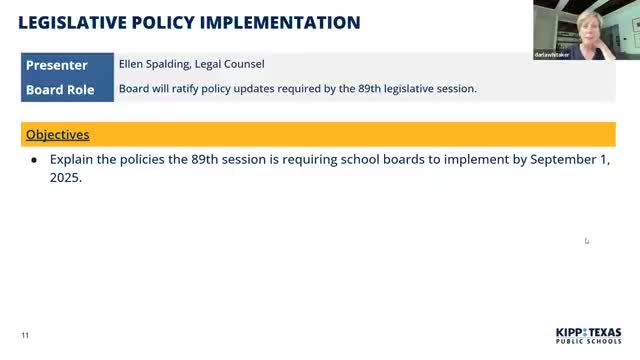
Summary
Legal counsel outlined multiple new state requirements — including changes to misconduct and child-abuse reporting timeframes, parental-engagement policies, limits on DEI duties and new library-material approvals — and the board unanimously approved a comprehensive policy package to meet Sept. 1 deadlines.
KIPP Texas’ board on Aug. 28 unanimously approved a comprehensive set of policy updates designed to comply with recent Texas legislation that the district’s counsel said requires certain policies to be in place by Sept. 1, 2025.
Ellen Spalding, KIPP Texas legal counsel, summarized several statutory changes and said the board must adopt policies addressing them. “Many of those laws require us to adopt specific policies prior to 09/01/2025,” Spalding said. She told trustees the policies will likely require fine-tuning as the Texas Education Agency (TEA) issues additional guidance.
Spalding highlighted reporting changes in Senate Bill 571 that shorten or clarify timelines and reporting pathways for alleged employee misconduct and child abuse. For alleged serious misconduct by employees or service providers involving students, Spalding said a school leader and the superintendent/CEO must make a report and that the new process requires notification to TEA within 48 hours; she told the board that child-abuse reporting — previously a 48-hour requirement when suspicion arose — “has now changed to 24 hours.”
The counsel also reviewed provisions she called part of a large parents’-rights measure (referred to in materials as SB 12) that require boards to adopt parental-engagement policies, provide an online point of contact for parents, and to prioritize public comments at the beginning of meetings. She said the new rules require boards to schedule some meetings outside typical work hours (interpreted as 8 a.m.–5 p.m.).
Spalding described new restrictions on DEI (diversity, equity, inclusion) practices as defined by the legislature, saying the policy must bar assigning DEI duties to employees, contractors or volunteers and may subject employees who violate the policy to discipline up to termination after any applicable due-process process. She emphasized that the policy does not prohibit celebrations of heritage months or student clubs: “This policy does not prohibit KIPP from allowing there to be celebrations of heritage months or allow or prohibit KIPP from allowing clubs related to heritage or things that would be prohibited to teach about,” Spalding said.
Other changes reviewed include updated requirements for School Health Advisory Councils (SHACs), limits on board membership where an individual has a substantial interest in a vendor that contracts with KIPP (described in materials as House Bill 210), and new board responsibilities for approval of library materials acquisitions and donations; Spalding said the TEA is still producing guidance on these provisions.
Patricia Ponton asked whether a vendor with no relationship to KIPP would create a conflict; Spalding replied that the prohibition applies when the person has a substantial interest in a vendor who has a relationship with KIPP. The board then moved to approve the comprehensive policy packet; the motion passed unanimously.
Spalding asked the board to permit additional refinements in executive session for matters requiring attorney advice; the board indicated it would accept further legal refinements as TEA guidance becomes available.
The resolution to adopt the comprehensive new legislation and related policies passed in open session with no recorded abstentions.