
Commissioner Thomas summarizes League of Cities conference: AI, workforce development and property tax risks
Get AI-powered insights, summaries, and transcripts
Subscribe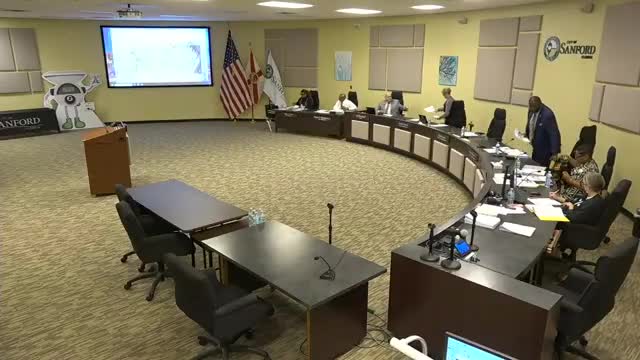
Summary
Commissioner Thomas on Aug. 25 summarized sessions she attended at the Florida League of Cities conference, highlighting AI applications, youth workforce development and property-tax issues that state lawmakers and municipalities are debating.
Sanford — Commissioner Thomas reported to the Sanford City Commission on Aug. 25 about sessions she attended at the Florida League of Cities and related National League events, covering artificial intelligence, youth workforce programs, minority business tools, and recent Florida legislative activity affecting local taxation and funding.
Thomas, who represented Sanford at the conference, told the commission the sessions she attended offered practical examples and tools officials could adapt locally: youth workforce development programs, downtown placemaking and marketing, minority and small-business procurement models, and municipal uses of AI for traffic management, public safety and customer service. "We talked about the 10 areas of AI, that you use AI for traffic management, public safety, emergency management, customer service, maintenance, waste management, decision making, urban planning, cybersecurity, and fraud detection," she said.
Why it matters: Thomas stressed that cities must strengthen disaster preparedness, digital resilience and workforce pipelines. She cited statistics presented at the conference — including widespread cyberattacks on public-sector targets in 2024 and the large cost of climate-related disasters — and said the information underscored the need for local action on resilience, cybersecurity and training. She also recommended improving local small-business access to procurement and co‑op contracts, noting many small firms do not know how to use procurement portals.
State-legislative brief: Thomas briefed the commission on Florida property‑tax trends discussed at the conference, including proposals for expanded homestead exemptions and changes that could shift revenue pressure between property-tax payers and service demands. She warned that homestead exemptions and assessed‑value dynamics have a significant effect on municipal revenue and cited conference material showing some communities rely heavily on homestead property tax revenue. Thomas summarized recent Florida legislation (including references to SB 2500 and HB 180 in conference panels) and urged staff to track potential Tallahassee impacts and to coordinate with the League’s legislative updates.
Local follow-ups: Thomas said she will work with staff and economic development to adapt conference ideas to Sanford, including expanding youth workforce programs tied to municipal hiring, promoting procurement training for small local firms, and exploring event-and-street activation ideas used in larger downtowns. She praised the conference’s practical, peer-to-peer sessions and encouraged the commission to keep sharing takeaways when members attend conferences.
Ending: Thomas closed by offering to share her full notes with staff and fellow commissioners and suggested city staff evaluate which conference recommendations could be implemented locally. "We learned about the city of Houston's MWOB program ... and people partnerships and possibilities," she said, urging staff to adapt relevant programs to Sanford’s needs.