
Sanford consultant briefs commission on why proposed fire assessment follows Florida law after Ocala refunds
Get AI-powered insights, summaries, and transcripts
Subscribe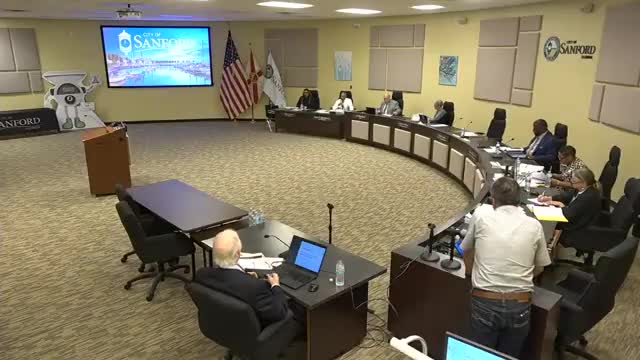
Summary
Mike Burton, a consultant who designed and defended Cape Coral’s fire assessment methodology, told the Sanford City Commission on Aug. 25 that Sanford’s draft non ad valorem fire assessment follows Florida statute and case law, distinguishing it from a fee the courts struck down in Ocala.
Sanford — A consultant told the Sanford City Commission on Aug. 25 that the city’s proposed non ad valorem fire assessment meets Florida statutory and case-law requirements and is unlikely to face the legal fate of a fee the courts struck down in Ocala.
Mike Burton, a consultant who said he designed the Cape Coral assessment methodology and served as an expert witness there, summarized two Florida cases and explained the difference between a utility “fee” and a statutorily governed non ad valorem “assessment.” He said Ocala’s 2011–2020 fire services charge was imposed as a utility fee and later found by the courts to be an unconstitutional tax; the courts ordered refunds of about $80 million. "In 2020, the courts found the fire services fee to be an unconstitutional tax," Burton said.
Burton told commissioners Sanford’s draft assessment follows the state’s non ad valorem statutes and the two-tier “availability/readiness-to-serve” method validated by the Florida courts in Cape Coral. "Once the Florida Supreme Court affirms an assessment, other municipalities can safely adopt the same approach without fear of it being invalidated," Burton said, describing the Supreme Court’s 2015 affirmation of Cape Coral’s methodology.
Why it matters: the distinction between a fee placed on utility bills and an assessment placed on property tax rolls has been decisive in recent litigation. The Ocala suit succeeded because plaintiffs argued the city’s charge functioned as an unauthorized tax — the court found it lacked direct service, offered no meaningful opt-out and was coercively bundled into utility billing. Burton summarized the Ocala ruling: the charge failed the tests courts use to distinguish user fees from taxes — "service exchange, specific benefit, and voluntary payment." He said the remedy in that case was a refund order covering roughly 10 years of collections.
How Sanford’s approach differs: Burton explained that non ad valorem assessments are governed by state statute, allow apportionment to property owners on the tax bill, and require specific procedural steps such as property-owner notices. He described Cape Coral’s two-tier method — a uniform Tier 1 availability charge plus a Tier 2 rate based on a property-improvement proxy — and noted the Cape Coral approach was validated in a bond-validation hearing and upheld by the Florida Supreme Court in 2015. "The availability method itself became legally endorsed across Florida," Burton said.
Commissioners and staff asked procedural questions and compared Sanford’s draft to Ocala’s earlier practice. City staff had requested the presentation after concerns surfaced about the Ocala litigation. The city manager introduced Burton’s remarks by saying the presentation was meant to show how Sanford’s process differs from Ocala’s and to build confidence in the proposed assessment.
What was not decided: the session provided information but recorded no formal action or vote on adopting an assessment or seeking bond validation. Burton recommended consulting the city attorney or special counsel, and commissioners did not vote on next steps during the work session. The consultant said if the commission wanted additional legal analysis or formal validation, the city attorney and special counsel (identified in the presentation) should be consulted for detailed review.
Background details cited in the presentation: Ocala originally adopted a fire services fee (placed on utility bills) and collected it for about 10 years before a class action challenged it; a refund order of approximately $80,000,000 followed. Cape Coral adopted a two-tier availability/readiness-to-serve assessment, validated in circuit court and affirmed by the Florida Supreme Court in 2015; that decision has been cited by other Florida municipalities adopting similar methodologies. Kissimmee was described as a separate example that later adopted a Tier 1/Tier 2 assessment billed on the property tax roll and estimated to raise roughly $6,000,000 annually when it goes into effect on Oct. 1, 2025.
Ending: Commissioners did not adopt any ordinance at the work session. Staff and legal counsel were asked to remain available for follow-up questions; Burton suggested the city attorney or special counsel review the statutory and case-law materials if the commission wants additional legal certitude or a bond-validation path. "If there's additional verification or specific legal analysis desired, I'd recommend that your city attorney or your special counsel, Chris Rowe, be consulted," Burton said.