
Sanford staff proposes Goldsboro "hybrid CRA" with Main Street administering local funds
Get AI-powered insights, summaries, and transcripts
Subscribe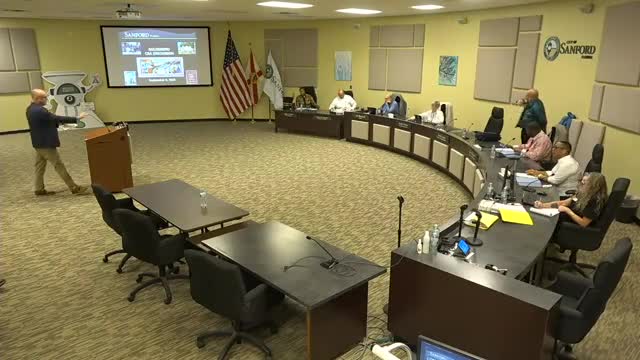
Summary
Economic development staff proposed Sept. 8 establishing a locally administered redevelopment program focused on historic Goldsboro Boulevard, to be administered by Goldsboro Main Street with City of Sanford oversight.
Economic development staff presented a plan Sept. 8 to create a locally administered redevelopment program for the Goldsboro neighborhood, saying the proposal would be operated by Goldsboro Main Street with City of Sanford oversight and an initial funding profile tied to tax-increment-like revenues.
Brady Lessard, Sanford’s economic development director, framed the proposal as a “hybrid” — not a traditional state-certified Community Redevelopment Area (CRA) requiring county or state partners — but a city initiative to re‑deploy a portion of taxes generated within the mapped Goldsboro boundary into neighborhood improvements. Lessard said staff and Main Street agreed that the highest near-term impact should focus on historic Goldsboro Boulevard and adjacent blocks, with a suggested mix of facade grants, public art/hardscape, festivals and targeted beautification.
Lessard said the program could begin Jan. 1 operationally and estimated a near-term funding baseline of about $75,000 annually (staff noted the city already budgets roughly $36,000 for Main Street, and the proposal would effectively continue or modestly increase that commitment). He said the plan calls for a funding formula tied to increasing taxable value over time so community members can “see that progress” in annual allocations.
Lessard said Goldsboro Main Street has pledged, in preliminary discussions and a recent letter, to administer the program and to accept a staff liaison (Julie Schofield was identified as the Main Street staff liaison). Kenneth Bentley, a Goldsboro Main Street board member present at the meeting, confirmed TDC (Tourist Development Council) grant activity and said some TDC grants had been delayed by county budget actions; Bentley said Goldsboro has recently been awarded TDC funds but that timing depends on county millage decisions.
Commissioners asked detailed questions about geographic boundaries (the administration team proposed using the original historic boundary rather than a broader, industrial-inclusive boundary), permissible uses, rollout and safeguards. Commissioners and staff discussed whether funds should roll over year-to-year (staff recommended yes), the need for parameters in an enabling ordinance (for example limits on amplified music near residences, residential vs. commercial facade eligibility), and whether the city would keep final approval of grants. Lessard and city legal staff said the commission could require annual budgets and consent/approval of individual grants as part of the enabling ordinance to maintain city oversight.
Why it matters: Goldsboro is a historically Black neighborhood that city staff and community leaders have long sought to revitalize. The proposed structure seeks to target smaller, neighborhood-specific investments while avoiding the multiagency, consultant-driven expense of creating a traditional CRA. Lessard estimated that a traditional CRA could cost $300,000–$400,000 to set up and would require more external partners.
Outcome at the session: The commission directed staff to draft an enabling ordinance and work with Main Street and city legal staff on parameters, an exhibit of bylaws if appropriate, and an implementation timetable to return for commission review. No ordinance was adopted at the work session.