
Commission hears plan to raise canopy to 25% by 2035; consultants recommend community forester and stronger tree protections
Get AI-powered insights, summaries, and transcripts
Subscribe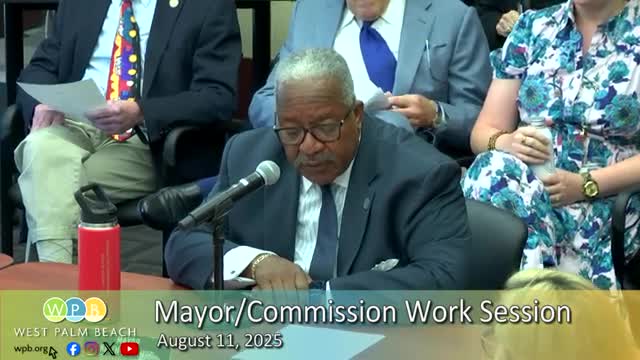
Summary
Consultants told the City Commission Monday that West Palm Beach’s urban tree canopy measures about 24% (34% including Grassy Waters Preserve) and recommended a strategy to increase canopy to 25% by 2035 through planting, stronger ordinances, tracking and a proposed community forester position.
City of West Palm Beach commissioners on Aug. 11 reviewed an updated tree canopy assessment and a set of strategies aimed at increasing urban canopy to 25% by 2035, consultants and city staff said. The presentation said the city’s developed urban area has about 24% canopy cover (34% when Grassy Waters Preserve is included) and recommended planting roughly 12,620 trees across the next decade to meet the target.
The plan’s authors, Karen Firehawk of the Green Infrastructure Center and staff from the Office of Sustainability, recommended a mix of municipal plantings, private-sector engagement and code changes. "Right tree, right place is the mantra," Firehawk said, arguing for intentional planting, long-term maintenance and targeted work in the hottest, least-shaded neighborhoods.
Why it matters: Urban trees reduce heat-island effects, improve air and water quality, absorb stormwater and provide other public-health and safety benefits. City staff and the consultant stressed that planting alone will not be enough without funding for follow-up care and enforcement to prevent early mortality of newly planted trees.
Most important facts
- Current canopy: about 24% across the city’s urban area; 34% when Grassy Waters Preserve is included, the consultant said. The presentation noted prior canopy loss of roughly 6% over a five-year period cited in earlier work.
- Goal and scale: The consultant proposed a goal of 25% canopy by 2035, which the team said equates to adding about 12,620 trees over 10 years. The plan breaks that into public- and private-side actions: roughly 2,524 trees on public lands (about 252 per year over 10 years) and an additional target of roughly 1,000 private-property trees planted annually (more than 10,000 private trees over the decade). City staff clarified wording in the slides after commissioners raised confusion about whether some counts were annual or 10-year totals.
- Key strategies: hire a community forester to lead neighborhood outreach and post-planting follow-up; establish a tree advisory board; strengthen ordinances and development standards (soil volume, tree pits, root protection, survival bonds for developers); prioritize plantings on the hottest streets and in areas where street-shading is lowest; and monitor progress with periodic canopy mapping (recommended every 4–5 years).
- Maintenance and contracts: The consultant said existing contracts for watering and maintenance did not ensure multi-year survival; a prior contract described two weeks of post-planting watering, which the consultant said is inadequate for Florida summers. The plan recommends contract standards that require longer-term watering and maintenance and bonding to ensure trees survive initial establishment.
Discussion and clarifications
Commissioners pressed several implementation details. President Lambert asked whether the city itself would plant 2,524 trees or simply oversee that number; the consultant and staff clarified that the 2,524 figure refers to the total number of trees targeted on city-owned land over 10 years and that implementation would combine city plantings with partnerships and giveaways. Commissioners also asked whether the plan recommends specific tree species; Firehawk said species lists and prohibited street trees would be proposed later as part of ordinance/code recommendations rather than in the initial report.
Commissioner Warren and others asked about maintenance costs and who would be responsible for long-term care. Firehawk replied that yard trees impose relatively low maintenance costs on homeowners but emphasized the need for watering and pruning contracts for trees planted on public property, and recommended a community forester to help with neighborhood outreach, long-term monitoring and partnerships with HOAs and nonprofits.
Next steps and staff direction
The consultant recommended that the commission adopt the canopy plan and the 1% (citywide) increase goal, task staff with implementation planning, and consider creating a community forester position in a future budget cycle. City staff signaled they will provide clarified wording for the slides and follow up with details on species recommendations and a budget worksheet that the consultant said had been prepared earlier.
Ending
Commissioners thanked the presenters and asked staff to circulate clarifying materials. No formal vote or ordinance was taken at the work session; staff were directed to return with implementation details, cost estimates and draft code language for future consideration.