Get Full Government Meeting Transcripts, Videos, & Alerts Forever!
Get email alerts on the Urban Agriculture Chickens topic
No spam. Unsubscribe anytime.
Lafayette council approves one‑year pilot to allow backyard hens after heated public debate
Summary
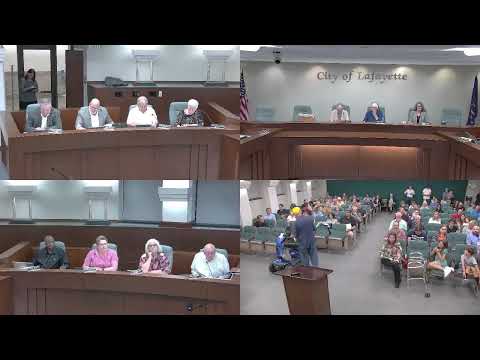
After more than two hours of public comment, the Lafayette City Council on Tuesday approved Ordinance 2025‑30 permitting up to five hens per property with a one‑year sunset and permit requirement. Supporters cited education and food access; opponents warned of disease, predators, odor and neighborhood conflict.
The Lafayette City Council voted to adopt Ordinance 2025‑30 at its September meeting, allowing residents to keep up to five hens on qualifying lots with no roosters, a required free permit, identification on birds and a one‑year sunset review if passed. The ordinance sets a 10‑foot setback from property lines and requires coops and pens to be at least 20 feet from neighboring houses unless the house is the owner’s.
Council President (Madam President) summarized the ordinance’s key points before public comment, saying it would require “coops and pens must be located at least 10 feet from neighboring property lines,” and noted the one‑year sunset so the council could review the policy if adopted. She and staff described the permit as a tracking tool rather than an inspection program; enforcement would proceed on a complaint basis through animal control.
The matter drew a large public turnout. Speakers opposing the ordinance raised public‑health and nuisance concerns. Gary Nolan, who said he worked decades for the U.S. Department of Agriculture, pointed the council to federal guidance and outbreak reports: “Poultry can sometimes carry harmful germs and make people sick,” he said, and cited CDC summaries of recent multistate salmonella investigations. Neighbors described recurring odor, animals in driveways and damage to relationships between neighbors. Lisa Schrader said a nearby coop had caused chickens to roam into her driveway and that even coops farther than 10 feet had produced noticeable odor.
Supporters said the ordinance contained restrictions that would limit proliferation and that other cities have managed similar programs. Hillary Bataille cited examples including Somerville, Fort Collins and Madison and said their municipal programs “have been tested in several cities, and it’s working.” Several parents and children described educational benefits and access to fresh eggs.
Council discussion emphasized enforcement limits and local context. A council member clarified setback language for the audience, explaining the ordinance requires a 10‑foot setback from every lot line and that coops must not be within 20 feet of a neighbor’s dwelling. Staff explained the permit application will require applicants to affirm compliance with the objective rules but will not include an initial field inspection; animal‑control officers will respond to complaints.
On the roll call vote the ordinance passed after a tie prompted the council president to cast the deciding vote. Voting Aye: Pinker, Snyder, Weese, Brown and the council president (tie‑breaking vote). Voting No: Reynolds, Eilersmeyer, Williamson and Downing. The ordinance took effect as adopted on second reading.
Supporters pointed to the one‑year sunset as a built‑in review mechanism; opponents urged caution and asked for clearer enforcement resources. The council did not adopt an inspection program as part of the permit; staff said complaint‑driven enforcement and education would be the primary tools.
The council also noted that private restrictions such as homeowner association rules or private landlord contracts would continue to supersede the city’s allowance where applicable. The measure includes limits and sanitation language intended to reduce nuisance and public‑health risk, and the council said it would revisit the program after the sunset period.