
Hampshire County approves pilot AI apprenticeship; commission requires county residents be prioritized
Get AI-powered insights, summaries, and transcripts
Subscribe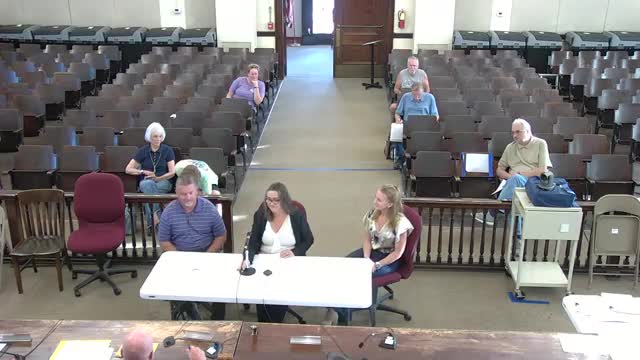
Summary
The Hampshire County Commission approved a $4,600 pilot grant for a two-apprentice AI development program led by Lendoo Solutions, requiring apprentices be Hampshire County residents and a 60-day progress update to the commission.
The Hampshire County Commission voted Tuesday to provide start-up funding for a pilot artificial-intelligence apprenticeship that organizers say will train two local apprentices to build AI tools for county services and local employers. Lee Ann Wiecki, CEO of Lendoo Solutions, told commissioners the program will “train two apprentices drawn from local high schools, our local community college, and homeschoolers to design, configure, and deploy AI agents.” She added, “These aren't abstract exercises. The work products will directly support Hampshire County's ability to deliver more effective services for our residents.” The commission's approval funds the initial three-month pilot. The motion passed with the requirement that apprentices supported by county funds be Hampshire County residents, that funds be drawn down monthly, and that the commission receive an update within 60 days of the pilot's start. The nut graf: County leaders said the pilot is intended to produce measurable work products—software “agents” that can automate tasks such as chat-based public-service helpers or dashboards—and to position the county for larger grants if the pilot succeeds. Organizers described the pilot as a collaboration between Lendoo Solutions, Eastern West Virginia Community and Technical College and the Hampshire County Development Authority. Lauren Arbaugh, representing Eastern, said the college is preparing AI coursework and has workforce-side microcredentials planned. John Todd Haught, director of the Hampshire County Development Authority, said his board will consider whether to provide additional funding if the pilot expands. Wiecki told the commission the training will follow Department of Labor apprenticeship standards and emphasized rapid, applied learning: apprentices will produce two AI agents during the first three months and, if the program continues, additional agents in a second phase. Wiecki also said her company would cover about two-thirds of the pilot cost and requested county support to demonstrate local commitment for future grant applications. Commissioners raised eligibility and outreach questions. Wiecki said she will prioritize Hampshire County residents and will advertise through schools, libraries and local networks; she described a screening process that includes references and a short assignment. Organizers said students could be in high school or college and that much of the instruction will be remote with several in-person sessions. The commission discussed funding sources. Commissioner Mance proposed the county approve the $4,600 to secure the pilot immediately, while encouraging further discussion with the Development Authority about longer-term support. Commissioner Brill and other commissioners emphasized that any applicants paid from county funds must be county residents. The commission recorded a motion, which passed with the required conditions, and commissioners said they would expect documentation of apprentice time and demonstrable deliverables. Organizers offered to submit time cards and receipts and to structure payments as reimbursements if the county prefers. The commission and organizers said the pilot will be used to pursue private and federal grant opportunities if successful. Organizers identified private foundation and corporate grant pools and Department of Labor apprenticeship grants as potential next steps; they said the pilot's measurable outcomes would strengthen future applications. The county will monitor the pilot and consider further funding or transition of the program to the Development Authority if the board decides that is the appropriate longer-term vehicle.