Southeast RAC accepts big-game recommendations, asks wildlife board to explain new mule deer model
August 27, 2025 | Utah Wildlife Board, Boards and Commissions, Organizations, Utah Executive Branch, Utah
This article was created by AI summarizing key points discussed. AI makes mistakes, so for full details and context, please refer to the video of the full meeting. Please report any errors so we can fix them. Report an error »
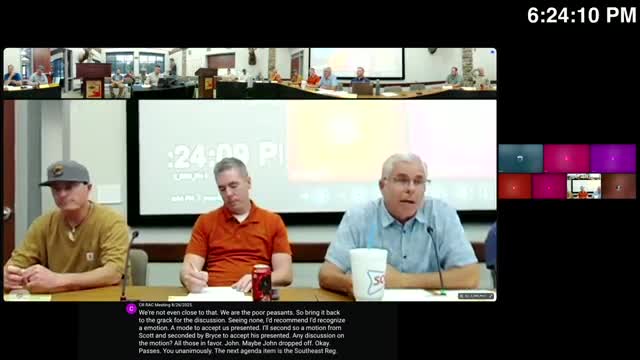
The request for a demonstration followed questions from RAC members and the public about a recent increase in modeled population estimates on several units, including the LaSal/LaSalle unit. At the meeting, Southeast Regional Manager Dustin Mitchell explained that a new, time‑specific modeling method produced the higher estimate and that managers are using the model to estimate populations without immediate changes to tag allocations.
RAC members said they support greater transparency about the model’s inputs and calculations. “It’s like a bank account pretty much,” Mitchell said in response to questions; he described the model as accounting for annual inputs (survival, harvest, recruitment) and outputs to estimate year‑end population. Members asked for a public demonstration or work session where staff would show a unit‑level example and the underlying data so stakeholders can review how the model produces results.
Why it matters: several RAC members and online commenters expressed skepticism after the new model increased some unit estimates substantially. Members said a clearer public explanation could build trust and allow stakeholders to review the raw data — harvest records, buck:doe ratios, collaring/survival data — used in the model. RAC discussion emphasized that changing an objective does not automatically change tag numbers; allocation decisions remain tied to management metrics such as buck:doe ratios and range condition.
Most important facts: Mitchell said the LaSalle unit’s modeled population sequence in recent years was about 6,500, 5,900, 5,500, 5,500 and then 8,800 under the new model; he said the increase followed a switch away from a model that averaged across years to one that uses time‑specific variables. He also said managers are running targeted hunts this year to reduce chronic wasting disease transmission in areas with higher prevalence and are monitoring neonatal survival and body‑condition measures.
Public input and outcome: the division received two online comments on the plans (one neutral and one dissenting on specific unit estimates). After internal discussion the RAC moved to accept the division’s recommendations; Tyson Scheem moved to accept and Bryce Castanetto seconded; the motion passed unanimously. Later the RAC moved that the Wildlife Board create an action‑log item for the division to present and educate RAC members and the public on the mule deer model; the RAC approved that request unanimously.
Context and next steps: RAC members and staff recommended the demonstration be unit‑specific and recorded for public viewing, and some suggested the division present at a board work session so the material is archived. Mitchell and other staff said they expect other regions to see similar model effects as their five‑year plan cycles come up.
Discussion vs. decision: the RAC’s votes were formal (accept plan; request board action item). Discussion included technical questions about model selection, data sources and whether the modeled increases should change management actions; RAC members repeatedly asked for more accessible demonstrations and public access to the model inputs.
View the Full Meeting & All Its Details
This article offers just a summary. Unlock complete video, transcripts, and insights as a Founder Member.
30-day money-back guarantee
Sponsors
Proudly supported by sponsors who keep Utah articles free in 2026

