
Commission reviews lobbyist-registration ordinance, directs staff to require lobbyists (not commissioners) to keep contact logs
Get AI-powered insights, summaries, and transcripts
Subscribe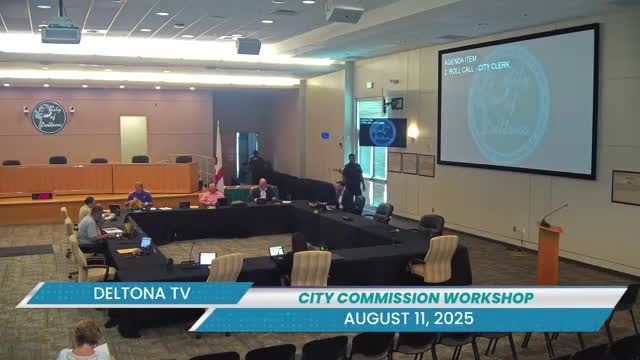
Summary
At an Aug. 11 workshop the Deltona City Commission discussed Ordinance No. 28-2025 on lobbyist registration, debated fee levels and scope, and directed staff to require lobbying contact logs from registered lobbyists only while returning with revised language and fee options.
Deltona City Commission members spent more than two hours on Monday, Aug. 11, discussing Ordinance No. 28-2025, a proposed lobbyist-registration measure designed to increase transparency about paid efforts to influence city decisions. The commission voted informally, by hand raise, to require lobbying contact logs from registered lobbyists only (4–3) and asked staff to return with revised ordinance language and fee options for formal consideration.
The city attorney said the ordinance “intends to do is Create transparency” by requiring compensated lobbyists who try to influence the commission, the city manager or other final decision makers to register, file an annual disclosure and pay a registration fee. The draft language presented at the workshop defined lobbying as “a communication…with any member of the City Commission, staff decision maker, or board member…in order to influence the action or inaction” of a decision maker, and it would require commissioners and other staff decision makers to keep quarterly logs of communications with registered lobbyists.
Commissioners focused on three contested issues: who must register, whether commissioners should also be required to file contact logs, and how high the registration fee should be. Vice Mayor Harriot urged placing the burden on paid lobbyists rather than elected officials, saying, “the onus needs to be squarely on the lobbyists.” Commissioner Lolly said the draft “does not have enough teeth” and asked for stronger penalties for officials who fail to disclose; the draft includes a civil fine of $50 per day for lobbyists who fail to register and gives the commission authority to publicly reprimand or ban repeat violators.
Members also debated scope language that would require lobbyists to list officers and any person holding “directly or indirectly at least 5% ownership interest” in a client corporation. Commissioner Howington warned that the indirect-ownership clause could obligate public companies to list mutual-fund shareholders and called the provision “excessive.” Several commissioners said a practical approach would require principals (applicants and owners) to register but waive fees for owner-occupied, single-family matters while charging fees to professional lobbyists or firms.
The draft’s registration-fee amount was a point of confusion and disagreement at the workshop. Some members read the draft as proposing a $500 fee; others discussed a figure of $5.25 in the packet. Multiple commissioners said they preferred matching the state model of $50 plus $25 for additional clients. The commission did not adopt a fee at the workshop and directed staff to return with clarified fee options.
Commissioners also discussed an exemption in the draft that would waive the registration fee for persons or representatives of organizations where a commissioner initiates a contact. Several members objected to any loophole that would exempt contacts initiated by commissioners; the city attorney said the section had been intended to limit the fee, not registration itself, and staff agreed to remove or revise the exemption language.
No ordinance was adopted at the workshop. Instead, the commission gave direction to staff: require lobbying contact logs from registered lobbyists (not elected commissioners), revise owner/ownership disclosure language to avoid impractical requirements for public companies, reconcile the registration-fee proposal with state practice, and bring back a redlined ordinance and options at first reading. The city attorney and manager said they would return with options and redlined language.
Why it matters: Commission members said the ordinance is aimed at reducing the perception or reality of undisclosed influence on city decisions and increasing public access to records of who is attempting to influence local policy.
What’s next: Staff will present revised ordinance language, fee options and alternative exemption language at a future meeting for first reading and further commission action.