
Terre Haute committee recommends withdrawing historic preservation ordinance after public debate
Get AI-powered insights, summaries, and transcripts
Subscribe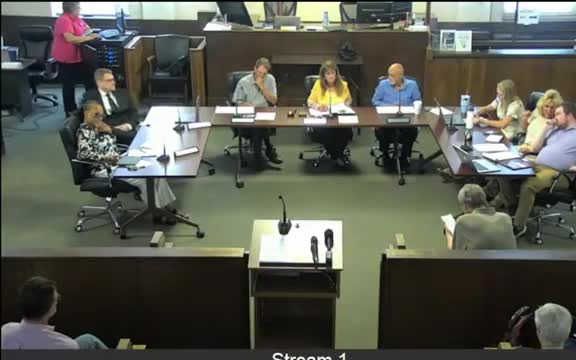
Summary
A city council committee voted to recommend withdrawal of General Ordinance 2 20 25, an enabling historic preservation ordinance, after an extended public-comment period and committee discussion about funding, staffing and neighborhood impacts.
A Terre Haute city council committee voted to recommend that the full council withdraw General Ordinance 2 20 25, an enabling historic preservation ordinance, after a lengthy public-comment period and debate among committee members.
The recommendation, made by Councilman John Azar and seconded by Councilwoman Michelle Thompson, passed on a voice vote; the committee indicated the ordinance, as written, should be withdrawn and revised before moving forward.
Why it matters: The ordinance would have created a local historic preservation commission and an enabling framework for design review and local historic-district designation. Supporters said the change is a modest enabling step that would help preserve neighborhoods such as Farrington’s Grove. Opponents argued the draft is too broad, lacks clarity on appointments and staffing, and could impose costs on homeowners and landlords without funding or enforcement guarantees.
Public comments ran more than an hour and a half and included both neighborhood residents and representatives of city bodies. Margaret Herdlich, immediate past president of Farrington’s Grove Historical District Inc., urged the committee to adopt the ordinance, saying it would “cause people to hit the pause button” and open opportunities for the city to negotiate compatible designs. She gave multiple examples from Farrington’s Grove of recent exterior work and demolitions she said an ordinance could have helped address.
Speaking for the Redevelopment Commission, Eddie Felling of Linden Felling Law Office said that body voted unanimously to oppose the ordinance as written and asked that it be withdrawn, arguing that it could “scare away future development.” Tommy Koechner, director of Indiana Landmarks’ western regional office, countered that an enabling ordinance merely provides a tool for communities to guide investment and protect historic character.
Committee members centered their objections on several recurring themes: the ordinance’s conformity with Indiana Code 36-7-11, the lack of explicit council approval language for commission appointments, uncertainty about which city department would staff the commission, and the absence of identified funding to support surveys, staffing or grant programs. Councilwoman Thompson said, “it is my understanding that there has been put in a line item, so that we can at least have the historical survey done,” and she and other members urged completing an updated historic-resources survey before moving forward.
Several public commenters said the draft ordinance could unduly burden low-income homeowners or landlords who often rent to students or households with limited resources. Zach Pritcher asked the committee to consider protections for residents who cannot afford repairs or historically faithful materials, saying the ordinance “as it stands” risks alienating populations already “thoroughly alienated.” Sylvester Edwards, president of the Greater Terre Haute NAACP, said requirements tied to historic standards could increase costs that landlords pass on to tenants.
Supporters, including members of the Historic Neighborhoods Coalition of Terre Haute, said the group began work on the ordinance months earlier and conducted outreach to council members, realtors and other stakeholders. Carrie Youssef said the coalition’s work “began long before the proposed rezoning of Ohio Boulevard” and that the group sought a public, data-driven approach. Margaret Herdlich cited approval rates for certificates of appropriateness from other Indiana cities (93% in Bloomington and 95% in West Lafayette in cited multi-year averages) to argue that local commissions tend to work with homeowners rather than punish them.
The committee’s final motion — by Councilman Azar, seconded by Councilwoman Thompson — directed that the ordinance be withdrawn “as it is written” and returned for further work. The committee’s recommendation will go to the full city council, where the draft could be revised, refiled or formally withdrawn.
Looking ahead: Committee members and other council members said they want additional work on the ordinance text, better clarity on appointment procedures to ensure local representation, a plan for staffing and budget (including use of surveys and potential grant or Community Development Block Grant support), and more public outreach. Several members noted that an updated historic-resources survey — last conducted in the 1980s, according to comments in the meeting — is budgeted for the 2026 fiscal year and would inform future ordinance language.
Votes at a glance: Committee recommendation to withdraw General Ordinance 2 20 25 — motion made by Councilman John Azar, seconded by Councilwoman Michelle Thompson; voice vote in committee passed with the committee recommending withdrawal to the full council.