
Lancaster school leaders hear NYSERDA‑approved plan outlining steps, costs to electrify bus fleet
Get AI-powered insights, summaries, and transcripts
Subscribe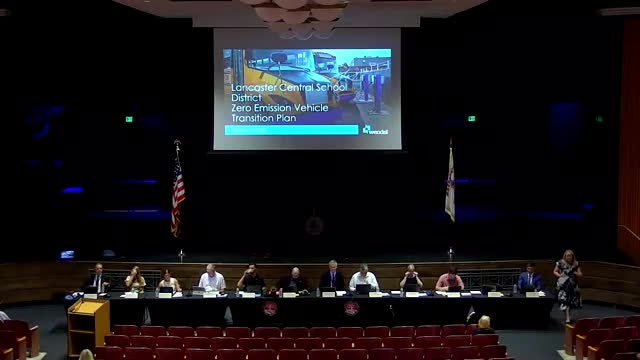
Summary
Lancaster Central School District trustees received a NYSERDA‑reviewed zero‑emission school bus transition plan that shows most routes are feasible with today’s battery buses but identified major utility and charging upgrades, an estimated phased infrastructure cost of about $26 million and a roughly $27 million vehicle premium compared with diesel.
Lancaster Central School District trustees received a presentation from district staff and Wendell consultants on the district’s NYSERDA‑reviewed zero‑emission school bus transition plan, which maps a phased approach to convert Lancaster’s fleet to buses powered by electric motors or hydrogen fuel cells to meet New York State timelines.
The plan, presented by Jamie Phillips of the district and consultants from Wendell — John Amarillo (principal in charge and director of alternative fuels), Katie Efrem (project manager, energy engineer) and Dante Gucci (technical lead) — lays out assumptions, route feasibility, utility impacts, infrastructure phasing and estimated costs.
The study found Lancaster’s existing population of roughly 90 buses (82 route buses, plus contracted vehicles) could largely be converted with current battery technology: approximately 79% of routes are feasible in the study’s “worst‑case” winter conditions. The consultants identified 17 routes that cannot be completed today by battery electric buses under the study’s conservative assumptions (full passenger loads, extreme cold, 15 minutes preheating, battery degradation to 90% of nameplate capacity and a further 11% safety factor).
Wendell modeled hour‑by‑hour energy demand for the district’s worst month and concluded that, without management, the connected charger load would be large — on the order of several megavolt‑amperes — likely pushing the site into medium‑voltage service (the consultants’ conservative estimate was about 2.5 MVA/13.8 kV). “Charge management is a software system that controls the chargers … Instead of 6,181, we’re gonna do 2,736,” the consultant said when explaining how software can reduce peak demand and infrastructure costs.
The consultants proposed a three‑phase infrastructure and bus procurement concept. Phase 1 includes an initial set of chargers, a new utility service and enhanced fire‑protection measures; the presentation estimated Phase 1 at about $11.6 million. The firm estimated total charging infrastructure and associated site work at about $26 million across phases. Separately, using state contract pricing estimates for battery‑electric buses, the consultants estimated replacing all 89 buses with battery electric models would increase vehicle acquisition costs by roughly $27 million compared with diesel over the same period. Combined, the presentation summarized the illustrative total differential at about $53 million (infrastructure plus fleet premium), noting escalation and contingencies were carried in the numbers.
Consultants described available incentives: a New York State school bus voucher program (described in the presentation as the “New York State School Bus Incentive Program (NISBET)”) with program voucher amounts (for example about $147,000 for a Type C bus in the consultant’s example) and a scrappage bonus if a diesel bus is scrapped to frame. The consultants said districts with an approved fleet electrification plan are currently eligible for additional vouchers (the presentation noted a cap of six vouchers plus an additional four tied to plan completion, for a total of 10 today). For chargers, consultants cited a charger voucher that, after completion of this study, they presented as $55,000 per charging position in the examples; the consultants also identified a utility “make‑ready” program that may cover up to 90% of utility‑side infrastructure costs. The presenters cautioned that voucher and program availability and terms may change.
Wendell also recommended enhanced fire protection for the bus garage because lithium‑ion battery fires require different firefighting equipment and water supply. The recommended package included a fire pump, pump house and diesel generator to support first responders and prevent spread to vehicles or the building; the consultants said current codes do not mandate these measures but that industry standards and insurer expectations are evolving.
District staff stressed the presentation was a conceptual plan and not a request for immediate board action. The superintendent and presenters said voter approval would be required for capital work and bus purchases in many scenarios and that the district will need to decide on a local procurement and phasing strategy before submitting grant or voucher applications. The consultant recommended a pilot — installing a small number of chargers on existing service and operating a few battery buses through a winter — to gather operational data before large‑scale construction.
Board members and community members asked technical and schedule questions during a Q&A. Consultants said long lead times for switchgear and transformers (they cited examples of 15–20 month delivery windows) and utility design time are a major scheduling constraint; one consultant said completing statewide conversion by the 2035 deadline would be “awful tight” given current lead times and the number of districts working concurrently. The presenters noted districts can apply for two separate two‑year waivers under state guidance (allowing up to four years of delay in some cases), but the consultants emphasized the statutory full conversion date currently in guidance remains July 1, 2035.
Next steps described by district staff included further board discussion, community outreach, decisions about pilot procurement, preparing voter authorization language where needed and advancing utility service requests so that detailed design and cost estimates can be obtained.
Questions that remain open from the presentation include final utility cost estimates (the consultants said final utility upgrade costs are unknown until the utility completes detailed design), the exact number of vouchers the district might obtain, the final phasing the board will approve and how future battery and bus offerings will affect the 17 constrained routes.
The presentation documents and the final Wendell report were reviewed and approved by NYSERDA and will be part of future board discussion materials as the district develops its local implementation plan.