
Buffalo Public Schools fall 1 percentage point short of math proficiency goal; district outlines expanded training and ALEKS rollout
Get AI-powered insights, summaries, and transcripts
Subscribe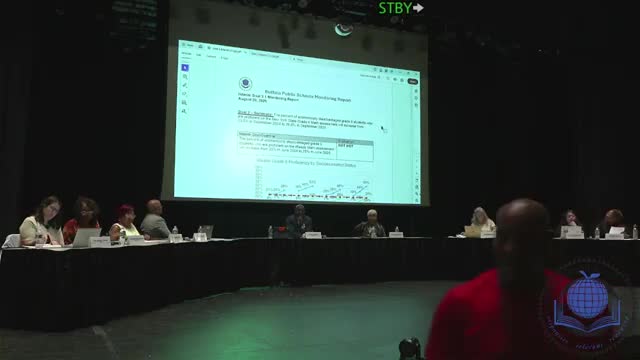
Summary
At the Aug. 20 Buffalo Board of Education meeting district staff reported that economically disadvantaged sixth-graders’ I‑Ready math proficiency rose to 24% in 2025, one point below the 25% target, and described next steps including expanded ALEKS implementation, additional training, site visits and continued use of RTI periods and math coaches.
At the Aug. 20 Buffalo Board of Education meeting district staff reported that the percentage of economically disadvantaged sixth‑grade students proficient on the I‑Ready math assessment rose to 24% in 2025, one percentage point below the board’s target of 25%.
District staff said the rise from 20% to 24% represents progress but fell short of the interim goal. "We missed the target by 1%," a district staff member presenting the monitoring report told the board.
The district attributed gains to the first year rollout of REVEAL (the K–8 math program) and the companion adaptive intervention ALEKS (grades 3–8), expanded teacher training, math learning communities, and regular data review with principals. Staff said schools also offered a daily 30‑minute math RTI (response to intervention) period and that participation in the Math League has grown.
Why it matters: the board set interim goals to raise proficiency and reduce the share of students performing well below grade level. Staff presented related data showing a multiyear decline in the percentage of students performing below grade level — from about 79% several years ago to 55% most recently — while noting targets were missed by a narrow margin.
What the district will do next: staff said they will "continue to analyze our data" and expand supports. Specific next steps presented included additional site visits and monitoring led by Assistant Superintendent for Curriculum, Assessment and Instruction Kelly Bautow and Director of Mathematics Jadon Wagstaff; additional professional development; tighter alignment with the Office of Shared Accountability; continued use of math coaches where available; and a phased rollout of ALEKS to lower grades (K–2) over the next two years.
During questioning, board members asked for more granular data, including school‑level participation numbers for Math League and comparative outcomes for students who participated in the competitions versus those who did not. A board member pressed whether math coaches are allocated based on need; staff replied that hiring a coach is a school‑based budgeting decision but that TOSAs (teachers on assignment) from the mathematics department provide support to buildings that do not have coaches.
Staff described a two‑phase professional development sequence for ALEKS (initial introduction followed by focused data‑interpretation training) and said there are currently four teachers on assignment supporting mathematics across elementary, middle and high school levels, plus three elementary coaches and other instructional coaches in some buildings. The district said TOSAs are expected to be in buildings 50% of their time during the week, with the remainder of time spent on curriculum development, contest preparation and planning for professional development.
Board members urged regular, scheduled refresher training for all teachers (including new hires) rather than relying solely on interventions triggered by low scores. Staff said they will schedule remaining teachers for the two‑part training and provide refreshers as data indicate.
No formal board action was taken on the math goals; the presentation was part of the board’s monitoring of its goals. District staff said they will return with additional data requested by board members.
The superintendent, Dr. Pascal Mupanga, who the presenter noted has a background as a math teacher, will be involved in the work moving forward.
Looking ahead, staff said they will continue to monitor implementation fidelity, expand ALEKS into lower grades over the next two years, sustain REVEAL year‑two implementation, and use a combination of TOSAs, building coaches and data analysis to target supports where needed.