
County seeks grant funding, bond authority for multiple sewer projects after DEC notice
Get AI-powered insights, summaries, and transcripts
Subscribe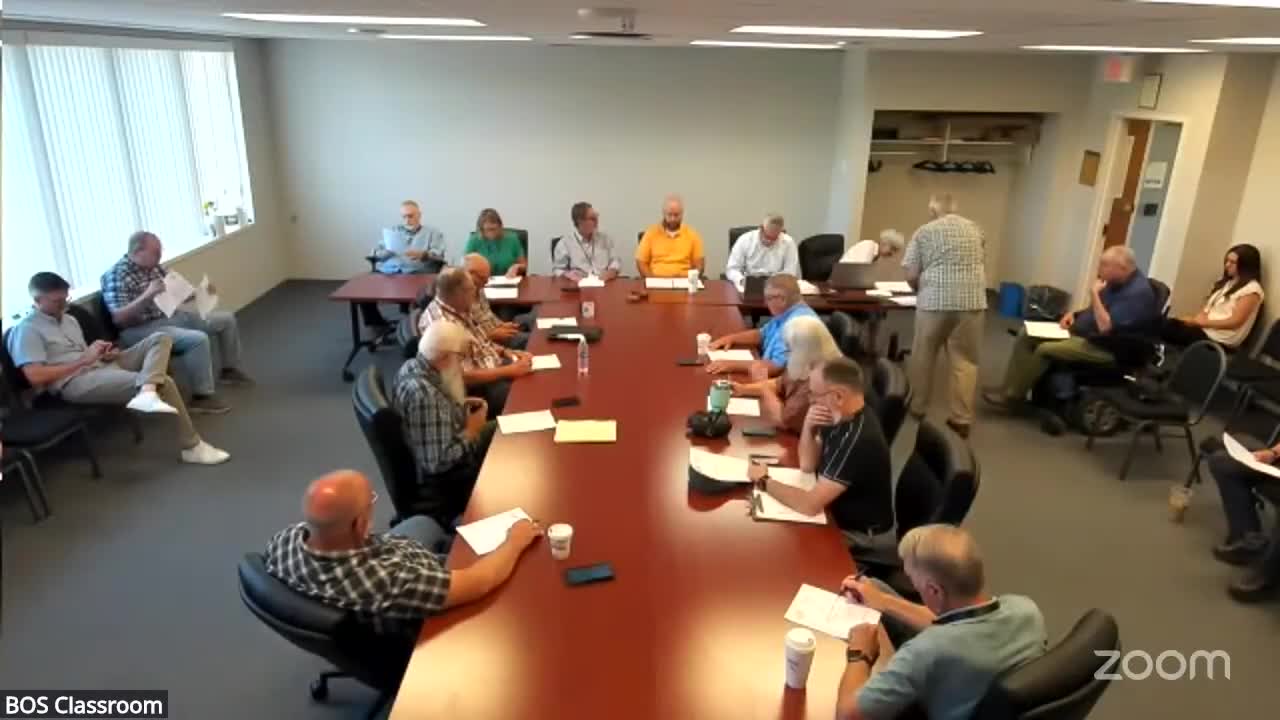
Summary
At the July 29 Washington County Public Works Committee meeting staff described a string of wastewater projects — including emergency pump station repairs, plant clarifier upgrades and slip‑lining work — and asked the committee to clear SEQR classifications and bond‑resolution language needed for grant applications.
Washington County Public Works staff told the committee July 29 the county will pursue state and federal grant funding and limited bond authority to pay for several sewer‑system capital projects after a notice of violation from the New York State Department of Environmental Conservation. The county described three priority projects: emergency replacement and rehabilitation at the Drifting Ridge and Argyle pump stations, upgrades to the wastewater treatment plant’s secondary clarifiers and completion of a previously started Sewer 1 slip‑lining and manhole rehabilitation project. Staff said the county will ask the full county board to declare certain projects Type II actions under the State Environmental Quality Review Act (SEQR) so grant applications can proceed without a coordinated SEQR review. The requested SEQR classifications and bond‑resolution language are necessary steps in the grant application process, county staff said, not an immediate commitment to spend. “Sanitary sewer overflows or SSOs are not permitted,” a staff member said, describing a DEC notice of violation tied to overflows at the pump‑station area. The staff member said the Drifting Ridge/Argyle pump‑station work is “replacement in kind” and therefore fits the Type II SEQR category; the committee voted to move the item to the county finance committee. Staff said the estimated capital cost for the Drifting Ridge and Argyle pump station project is $1,320,000; that bond‑resolution language is required by many grant programs so the county can demonstrate it can borrow if needed. “If we get all of the grants, we'll be somewhere between 80–90% grant, and then the rest will be us,” the staff member said when asked about local matching requirements. A larger treatment‑plant project involves rebuilding and expanding the plant’s secondary clarifiers. Staff described the clarifiers as “one of the final tanks that the sewage passes through” and said the county plans to replace or refurbish two existing clarifiers and add a third. The total project estimate for the two secondary clarifiers as presented is $19,560,000. Staff explained the current plant equipment is sized for a 7,000,000‑gallon‑per‑day throughput; a second overflow exists at 4,000,000 gallons per day. “The first overflow is 7,000,000 gallons per day of water coming in,” the staff member said. “The reason for that is because all of the equipment we have is sized for 7,000,000 gallons.” The committee moved that item to finance so staff can begin SEQR lead‑agency coordination and complete required grant paperwork. Staff characterized the Sewer 1 slip‑lining and manhole rehab project as complete and asked the committee to confirm a Type II SEQR classification so the county can finalize reimbursement paperwork for grants already awarded; that item was moved to the full board for confirmation. A separate budgeted pump purchase described as a sole‑source procurement also cleared the committee. Because the pump cost exceeded $50,000 the committee approved the sole‑source purchase and sent it on for full‑board action. The transcript contains two differing figures for the pump cost; the precise final purchase amount was not clarified at the meeting. No final borrowing or construction contracts were approved at the committee level; the actions recorded were motions to advance SEQR classifications, to authorize bond‑resolution drafting by bond counsel, and to forward grant‑application and procurement items to finance or the full board for final action. The committee’s actions reflect a mix of discussion (project descriptions and risk), direction (staff to prepare SEQR short forms and bond‑resolution drafts), and formal committee votes to forward items to finance or the full board for final decision. Looking ahead, staff said they will return to the committee and full board with finalized SEQR forms, bond‑resolution language and any awarded grant documents before construction contracts are authorized.