
Design team proposes all‑electric, geothermal and low‑carbon materials for Tompkins County center
Get AI-powered insights, summaries, and transcripts
Subscribe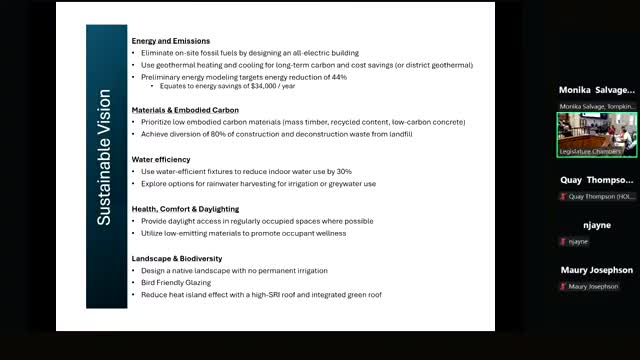
Summary
Project architects said the new Tompkins County Center of Government is being designed as an all‑electric building with geothermal heating and cooling, a preference for mass timber, low‑carbon concrete options and targets for construction waste diversion and water‑use efficiency.
Project architects told residents at a public meeting that the proposed Tompkins County Center of Government will be designed to meet a set of sustainability targets that include eliminating on‑site fossil fuels, using geothermal systems and prioritizing low‑embodied‑carbon materials.
Quay Thompson of Holt Architects said preliminary energy modeling for the proposed building footprint and volume shows a potential 44 percent reduction in energy use compared with a baseline model built to current energy code; the design team estimated that would equate to about $34,000 in annual energy savings in the model used for preliminarily testing.
"The intent is to eliminate on‑site fossil fuels and this will be an all electric building," Thompson said. He added that geothermal heating and cooling is a major component of that approach.
Materials and waste
The team said it is prioritizing mass timber for primary structure rather than structural steel where feasible, and evaluating low‑carbon concrete mixes for foundations and piles. Designers also said they are targeting an 80 percent diversion rate for construction and deconstruction waste to keep materials out of landfill.
Water, health and landscape goals
Designers said they aim to beat code baselines for water efficiency by roughly 30 percent through low‑flow fixtures and are exploring rainwater harvesting to supply non‑potable uses such as toilet flushing. The team also proposed bird‑friendly glazing where glass is used and native landscaping with no permanent irrigation to reduce the heat‑island effect.
Budget caveats
The design team stressed that many sustainability features are targets subject to final budget decisions. "Some of the things on this list are priorities, but they're all sort of pending budget, final budget decisions and things," Thompson said during the presentation.
Speakers included Quay Thompson (Holt Architects) and members of the design team who noted Tetra Tech and Tatum Engineering have roles in energy and carbon analysis; the county has not committed to a final sustainability certification or mandatory checklist for the project at this stage.