Get Full Government Meeting Transcripts, Videos, & Alerts Forever!
Get email alerts on the Water Conservation topic
No spam. Unsubscribe anytime.
Wimberley presenters ask city to promote ‘WaterWise’ outdoor conservation program
Summary
Local organizers presented WaterWise, a community education and incentive proposal focused on reducing outdoor water use through native landscaping, rainwater capture and hands‑on workshops; they asked the council to endorse and help promote events and consider incentives such as rain barrel subsidies.
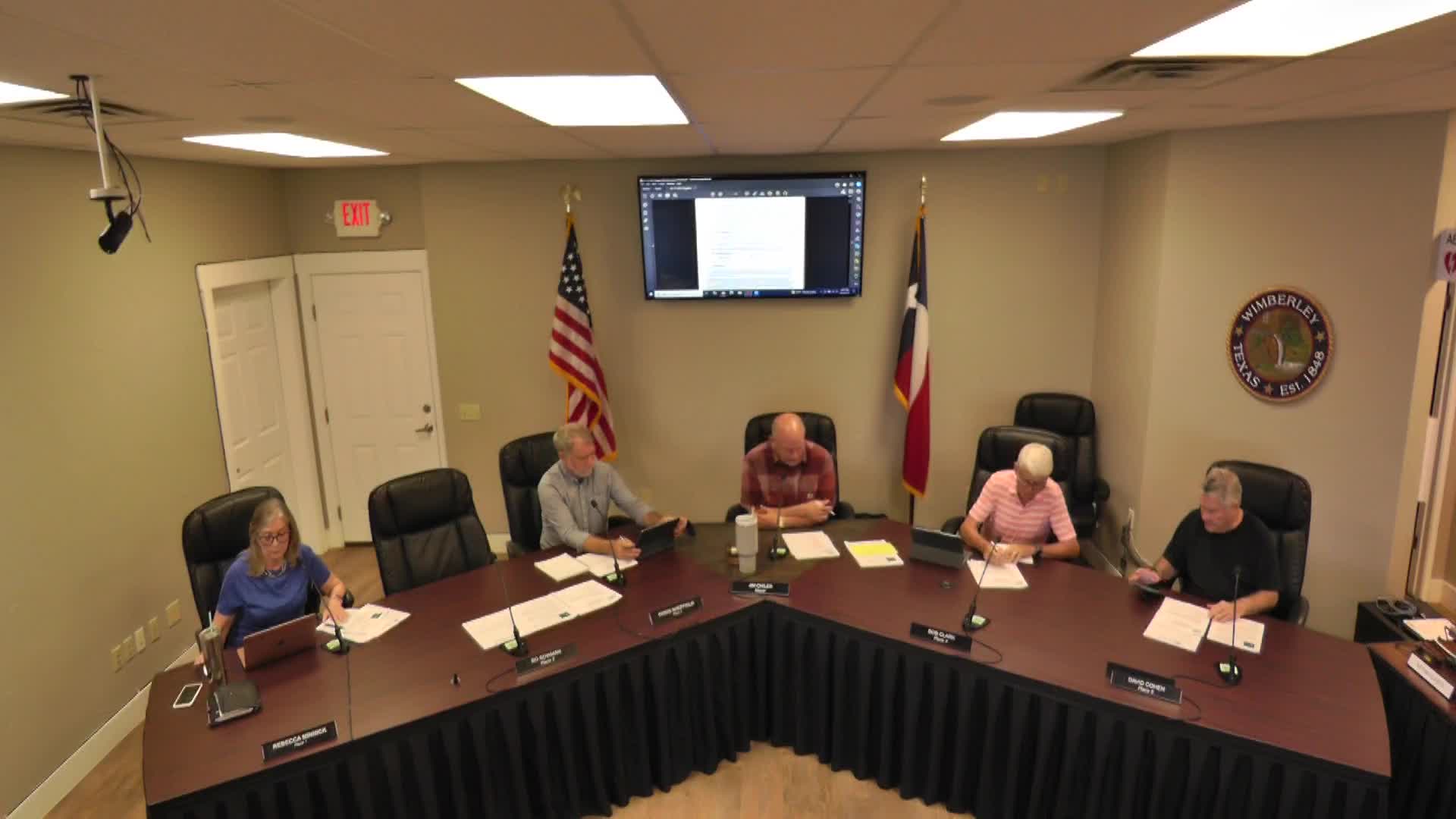
Salwa Khan and Zane Porterfield Liston asked the Wimberley City Council on May 15 to endorse and help promote “WaterWise,” a local outdoor water‑conservation education program that would link workshops, native‑plant demonstrations and hands‑on demonstrations such as stock‑tank wicking gardens and permeable pavers.
The proposal, organizers said, aims to reduce outdoor household water use — which they cited as accounting for up to 70% of typical U.S. residential water use — by teaching alternatives to conventional lawns, facilitating plant giveaways, and lowering barriers to rainwater collection and other on‑site measures.
At the meeting Khan, who described herself as a long‑time Wimberley resident and host of the Mothering Earth program, and Zane Porterfield Liston, who represents the Wimberley Valley Watershed Association, outlined planned partners including the Native Plant Society, Hays County Master Naturalists, the Meadows Center, the Groundwater Conservation District, Wimberley Garden Club and the Hill Country Alliance. They proposed starting the program in September with a series of public workshops and neighborhood demonstrations.
Khan cited EPA figures during the presentation saying an average 1,000‑square‑foot lawn requires about 35,000 gallons a year and that overwatering can push that figure higher; the presenters also estimated, during discussion, that some household lawns end up using roughly 75,000 gallons annually. The presentation suggested practical tactics — native shrubs and grasses, rainwater harvesting, wicking or stock‑tank gardens, berms and swales, and permeable paving — and described local demonstrations already available, including a water‑saving design at 1 Water School in Wimberley and a native garden tour.
Council members asked about rain‑barrel subsidy programs and logistics for promoting events. Khan said the group would help arrange bulk pricing and do basic teaching; she referenced municipal programs in Austin (roughly $50–$100 per barrel) and incentives elsewhere, and noted that San Antonio and Denton have implemented broader outdoor‑water incentives, including a recent Denton turf buyback program. City staff and councilmembers agreed to help promote events on city channels and in the municipal calendar; no formal incentive program or funding commitment was made at the meeting.
Organizers emphasized making materials and demonstrations accessible and linked to existing community organizations so the program could be sustained beyond the initial volunteers and presenters.