
Developer seeks demolition at 151 Old Kyle Road; commissioners press to preserve possible heritage oak
Get AI-powered insights, summaries, and transcripts
Subscribe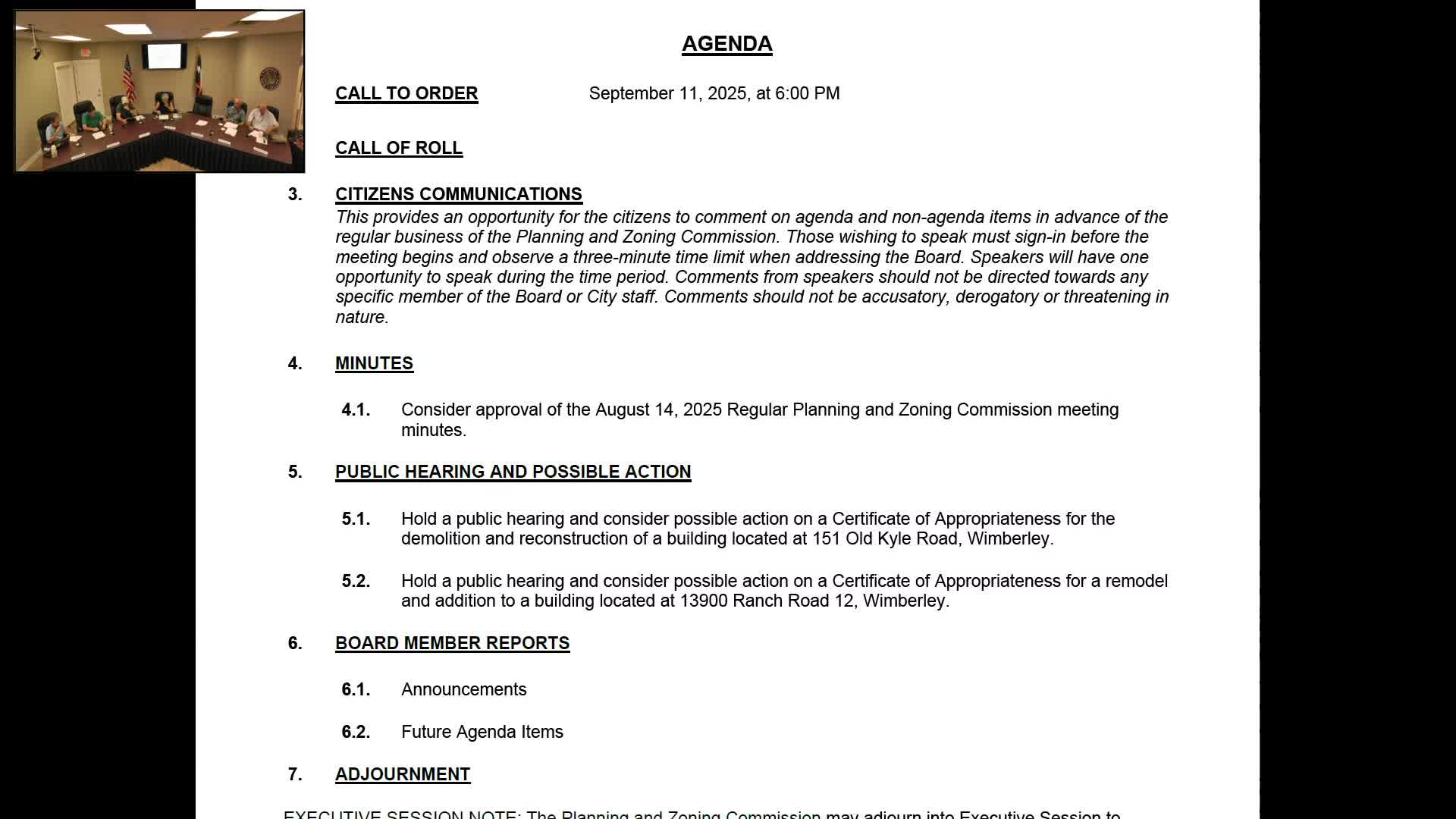
Summary
Developer Holden Highlander told the Wimberley Planning and Zoning Commission on Sept. 11 that he has submitted updated drawings for a proposed demolition and reconstruction at 151 Old Kyle Road and asked for feedback while the 60‑day demolition stay runs its course.
Developer Holden Highlander told the Wimberley Planning and Zoning Commission on Sept. 11 that he has submitted updated drawings for a proposed demolition and reconstruction at 151 Old Kyle Road and asked for feedback while the 60‑day demolition stay runs its course.
The item is before the commission as a certificate of appropriateness request for a property in the city’s historic preservation overlay; under the city’s process a 60‑day stay is already in effect and the commission cannot determine the demolition request until that period ends. The applicant showed elevations, a revised site plan and renderings and discussed material choices, removal of some railings and a change from pier-and-beam to slab‑on‑grade foundation that reduces building elevation.
The question of a large oak on or near the parcel dominated the hearing. Highlander said an independent survey measured the oak at 23.5 inches in trunk diameter, and he asked whether that half‑inch keeps it from qualifying as a “heritage oak.” Nathan (staff member) told the commission he had not taken the measurement issue to city council and said staff would prepare an ordinance to modify design guidelines while following the demolition process already adopted in ordinance form: "We have not taken that to city council yet. What we're gonna do is put together an ordinance that just modifies these design guidelines," he said.
Why it matters: If the oak is designated a heritage tree the project’s footprint and foundation could need substantial revision; if it is removed the owner would have to mitigate the loss by planting replacement trees or possibly paying a fee in lieu. Commissioners repeatedly urged preserving the oak where possible and asked for clear verification of the tree’s measurement before a demolition decision.
Most factual details from the hearing
- 60‑day demolition stay: Commission members noted the process requires the 60‑day period to elapse before the commission can make a determination on demolition; commissioners and staff said the commission may review and comment on design but cannot approve demolition until the stay concludes. Commissioner Anne Olfelder said she felt caution was warranted: "My feeling on it is, you know, how much we are advised not to approve demolition. And to approve demolition and the taking out of a possible heritage oak seems like a lot."
- Tree measurement and heritage threshold: The applicant provided a survey showing the oak at 23.5 inches (surveyor rounded up practice was discussed). Commissioners and the applicant agreed they would re‑measure at breast height together if needed. The commission discussed whether a 23.5‑inch reading falls short of a 24‑inch threshold referenced in the guidelines; staff and members treated that threshold as material to heritage status but did not claim a final determination that the tree is or is not a heritage oak.
- Mitigation if tree removed: Staff described mitigation requirements tied to caliper inches: the removed tree’s caliper inches would generally need to be replaced on the property (for example, by planting trees totaling equivalent caliper inches) and that up to part of the mitigation requirement can be satisfied by paying a fee in lieu. The exact price per inch was not specified at the hearing.
- Design details and changes requested by the commission: Commissioners gave design guidance to reduce the length of a continuous flat roof, add smaller porch roofs or gables over grouped door/window pairs to better match historic scale, and avoid a stark white appearance on the building face. The applicant said he planned to modify roof lines and revisit elevations with his architect and return next month with revised drawings.
- Parking and adjacent property: Commissioners and the applicant discussed adjacent parking owned/controlled by the next‑door property (formerly Hildy's, new owner referenced). Staff reminded the group that council previously removed a separate ordinance requiring additional parking; the commission emphasized that the applicant must meet code minimums including ADA access but that adding general parking on the parcel would reduce building square footage and might jeopardize the project’s financial viability.
- Timing and next steps: Highlander said he wanted to have design approval ready when the 60‑day stay ends to save a month; he estimated construction could take about nine months to a year after permits and utility hookups. Commissioners emphasized verification of the tree measurement, that staff will follow the ordinance demolition process, and that the applicant should return with revised plans addressing the tree and roofline suggestions.
Ending
No formal vote was taken on demolition or on a certificate of appropriateness at the Sept. 11 meeting. The commission kept the public hearing open on the demolition matter pending completion of the 60‑day stay and asked staff and the applicant to supply a clear tree measurement and revised drawings for the next meeting.