
Addison council debate turns to property-tax rate, compensation and budget priorities
Get AI-powered insights, summaries, and transcripts
Subscribe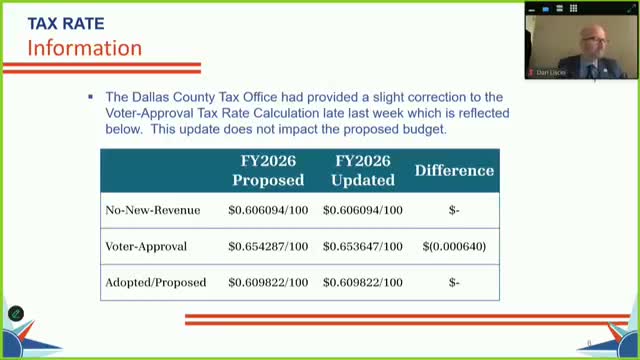
Summary
Council members pressed for a clear discussion of the town's property-tax rate after workshops showed many one-time projects and a proposed compensation step plan for police and fire. Some members urged lowering the rate; others warned of service cuts.
Addison — The Addison City Council spent a large portion of its Aug. 12 meeting debating the town’s property-tax approach for the fiscal 2026 budget, with members split between calls to lower the rate and warnings that cuts would reduce services residents value.
Steven Glitter, chief financial officer, told the council that the voter-approval tax rate calculation presented at the budget workshop was adjusted slightly by the Dallas County Tax Office (from a stated 65.4287 to 65.3647 in the materials). Glitter said the proposed budget keeps the town’s property-tax rate effectively unchanged and that the general fund changes under discussion are primarily driven by recurring employee compensation increases, especially a step plan for police and fire.
Council Member Randy pushed for an explicit tax-rate conversation and argued the council should have begun the budget process by setting a target rate rather than compiling a “wish list” of projects. “There is no reason we should not be lowering the property tax rate,” he said, adding that residents have not had a tax break in years. Randy said council should examine everything objectively and decide priorities rather than approving every request.
Other council members defended the proposed approach. Council Member Chris said residents value services and amenities that come from the budget and pointed to the town’s reputation for high service levels: “Most people don’t go to the athletic club, but we spend a lot of money over there,” he said, arguing that the town’s investments contribute to quality of life for residents and businesses.
Glitter and staff explained the interplay between different funds. Several one-time projects — such as parks improvements and theater upgrades — are funded with special or one-time revenue sources, not recurring property-tax dollars. Glitter said the proposed operations rate would remain lean while staff added approximately $600,000 in recurring employee compensation for public safety step increases; he noted that the general fund showed only about $11,000 in revenue over expenditures under the proposed property-tax rate, and the no-new-revenue option would require about $230,000 in cuts from the general fund to balance.
Council members asked technical questions about scale. Glitter said that each one-cent change in the tax rate would equal about $650,000 in total tax revenue for the town and that a one-cent reduction targeted at the general fund would translate to roughly $650,000 less available revenue for recurring operations or to cover new compensation packages.
Several members asked staff to bring a strategic conversation forward. Council Member Marlon said a focused strategic planning session in February would be the right forum to discuss target tax rates and the town’s long-term priorities. Council Member Dan said he supported the proposed budget overall but wanted assurances the council would pursue more revenue-generating options where available.
No change to the proposed property-tax rate was adopted at the Aug. 12 meeting. Staff advised that lowering the operations rate or using one-time funds to pay recurring costs would require explicit council direction and careful follow-up; staff also reminded the council that certain funds, such as special revenue accounts, are restricted for specific uses.
Why it matters: Property-tax rate decisions drive how much recurring revenue the town has for public safety, parks, maintenance and employee compensation. The council’s decisions this budget cycle will determine whether Addison scales back investments, redirects one-time funds or keeps services at current levels while pursuing targeted revenue or efficiency gains.
Next steps: Council asked staff to prepare additional information on the revenue/expenditure trade-offs, to run scenarios that show the impact of specific tax-rate changes and to include the topic in upcoming strategic-planning work so members can decide on an explicit tax-rate objective for future budgets.