
Addison staff seek funds for meter modernization, pump-station assessment and joint sewer inspection with Farmers Branch
Get AI-powered insights, summaries, and transcripts
Subscribe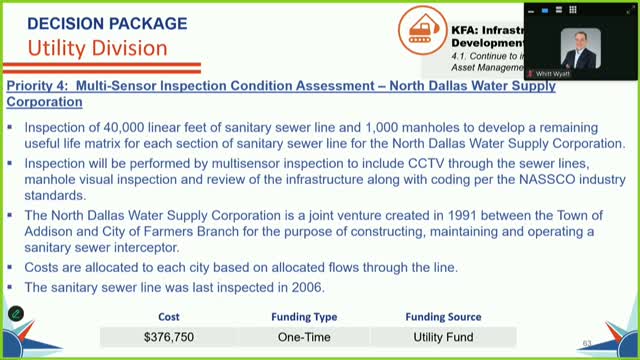
Summary
Public works staff requested decision-package funding to replace aging analyzers and control valves, assess an electrical cabinet at Celestial pump station, and share a multi-sensor inspection of a 40,000-foot joint sewer system with Farmers Branch; the council discussed cost-sharing and ordinance-defined percentages.
Addison public works staff outlined several FY2026 utility decision packages and a multi-jurisdiction sewer inspection that together aim to modernize water monitoring and identify needed pipeline repairs. Becky (staff member) described four decision packages: replacement of chlorine analyzers/pH/residual monitors across town (about $60,000), replacement of a control valve at the Surveyor water tower (about $40,000), an electrical assessment of the Celestial pump station (about $225,000), and a 40,000-linear-foot multi-sensor sanitary-sewer inspection tied to the North Dallas Water Supply Corporation joint system. Becky said the joint sewer inspection will evaluate approximately 40,000 linear feet and about 1,000 manholes and that Addison's share is roughly $377,000; Farmers Branch budgeted about $550,000 on its side. Staff noted the LCRR (lead and copper rule revisions) filing with the Texas Commission on Environmental Quality is complete and that lead-service-line investigations found five replaced lines and no other lead services remaining in town. Why it matters: the requests fund asset assessments or targeted replacements to reduce the risk of emergencies and inform capital projects; the joint sewer inspection will produce a NASSCO-coded condition matrix to prioritize CIP work and reduce the chance of emergency repairs. Council questions touched on how the joint inspection cost is apportioned: Ashley Short, deputy city manager, explained the North Dallas Water Supply Corporation was created as a local government corporation with a pre-existing ordinance that sets the cost-sharing percentages; staff said they'll include the ordinance percentage in the budget backup. Becky described the multi-sensor inspection as an industry-standard approach that allows the towns to prioritize later CIP investments. No formal action was taken; staff requested the funding be included in the proposed budget and said they will return with contract and ordinance language as backup.