
Webster County supervisors, EMS providers debate 28E rules, coordinator hire and reporting before levy funds arrive
Get AI-powered insights, summaries, and transcripts
Subscribe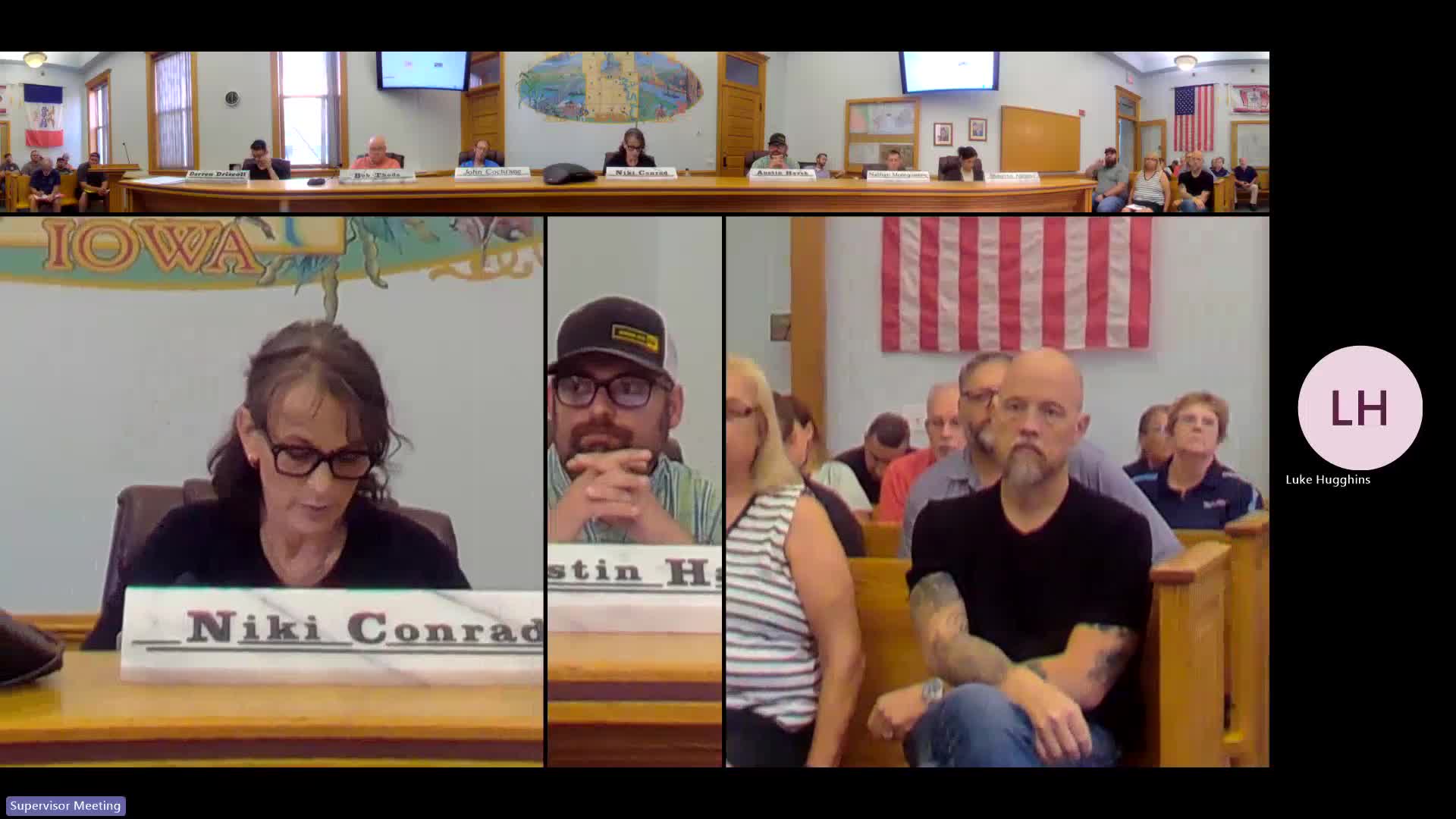
Summary
County supervisors, EMS directors and volunteers met in a June workshop to discuss how to implement the newly approved EMS property tax under Iowa Code chapter 422D — focusing on hiring a county coordinator, creating 28E agreements, budget coding and audit/reporting cadence before funds begin arriving in the fall.
Webster County Supervisor Nikki Conrad opened a special evening workshop to discuss implementation of the emergency-medical-services levy voters approved, saying the measure is authorized under state law and will run for a 15-year term.
Why it matters: The new levy will generate county-restricted EMS revenue that officials and volunteer services say must be coded, tracked and spent in ways that both meet statutory limits and let first-responder units keep operating. County staff and providers spent the meeting trying to balance speed of spending with auditability before revenue begins to arrive in the fall.
Webster County Supervisor Nikki Conrad, who chairs the meeting and sits on the countys EMS advisory council, read the ballot language that passed: "Shall the Board of Supervisors in the County Of Webster, State of Iowa medical services in the county pursuant to Iowa Code chapter 422D be authorized for a period of 15 years to levy and impose an emergency medical services tax..." That statutory reference framed most of the discussion about where money may legally be spent and how it must be tracked.
Terry Town, an EMT who identified herself as a Gary Ambulance director, longtime training officer and local fire-board treasurer, presented a detailed proposal calling for an early hire: "We need a coordinator hired to oversee these the running of this essential service funds and assist the volunteer units to gear up for what we promised our communities that we serve, that we would do." Town said the coordinator should keep skills current, visit multiple stations, help file insurance claims, apply for grants and have access to run data in ImageTrend so the coordinator can verify response activity.
County finance staff warned that the mechanics of paying claims and tracking spending will matter. "To my understanding, September is when, we will start collecting. So we don't really have any funds right now to be giving out," Webster County Budget and Finance Director Crystal Lloyd told the workshop. Staff said the county already has a dedicated trust fund established to receive EMS levy receipts, but the finance office needs line-item budgets and account coding before it can begin approving payments.
Former Webster County auditor Doreen Pleiner urged preapproval of invoices rather than retroactive reimbursement: "All invoices should be approved prior to the final purchase being made, and then they can send it to the auditor or to Crystal, the finance director, and she can make that payment right away, like, within 2 weeks." Pleiner and other finance staff described paying claims on a county claim cycle as the clearest way to keep receipts and documentation for later audit.
Providers pushed back on proposals they said would slow operations. Harcourt Fire Chief Ryan Bogue, speaking for a non-transporting volunteer service, said the levy was intended to replace fire-budget subsidies and fund day-to-day EMS operations: "The reason for that, in my eyes, is essential service is supposed to offset all the funds we currently use from our fire budgets for us that run fire calls too." Several volunteer leaders said they need predictable, locally available funds that can be used for wages, supplies and equipment, not a process that requires waiting weeks to fill an urgent equipment gap.
The group also debated frequency of reconciliations. Some supervisors and providers favored quarterly or semiannual reporting as a compromise between the countys desire for documentation and smaller services cash-flow needs; others, including the former auditor, emphasized pre-approval and keeping transaction documentation accessible for audits.
Several attendees recommended a needs assessment before final distribution rules are locked in. "One of the things that I think we should be looking at before we divvy out any money is a needs assessment of what departments actually need," said Dylan Hagen, Webster County emergency management coordinator. He and others said that a short-term, equipment-focused phase (for example, buying large-ticket items such as a Lucas device where several departments lack one) could be paired with longer-term operational budgets.
Equity and the levy formula surfaced repeatedly. The levy allocation model discussed by the advisory council uses tax base geography; some speakers warned that relying only on property valuation could leave lower-value areas relatively underfunded over time, while others said the advisory council intentionally built a set-aside (a $10,000-per-year allotment for non-transporting first-responder units) to ensure minimum support for volunteer units.
Legal and administrative constraints also guided discussion. Participants noted that Iowa Code chapter 422D requires EMS levy receipts to be held in an agency trust fund maintained by the county and that individual 28E agreements (intergovernmental agreements) will be required with each service or jurisdiction that receives funds. Attendees discussed including clawback provisions and probationary periods in those agreements for cases where services fall out of compliance or cease to provide EMS.
Next steps and outcome: County staff agreed to work with the state auditor and other counties to refine a practical claims and audit workflow; Budget and Finance Director Crystal Lloyd and County Auditor Shauna Abrams were asked to coordinate that work and report back. The EMS advisory council, which includes representatives from each quadrant of the county and the city of Fort Dodge, was asked to consider the draft 28E templates and provide final guidance to the supervisors. Supervisor Nikki Conrad invited written questions and bullet-point concerns to her county email to feed the advisory councils next meeting.
No formal decisions on 28E language, coordinator hiring, or distributions were made at the workshop; the meeting ended after a motion to adjourn was approved by voice vote.