
Board forms armed-educator and staff-recognition committees and opens debate on approach to cell-phone policy
Get AI-powered insights, summaries, and transcripts
Subscribe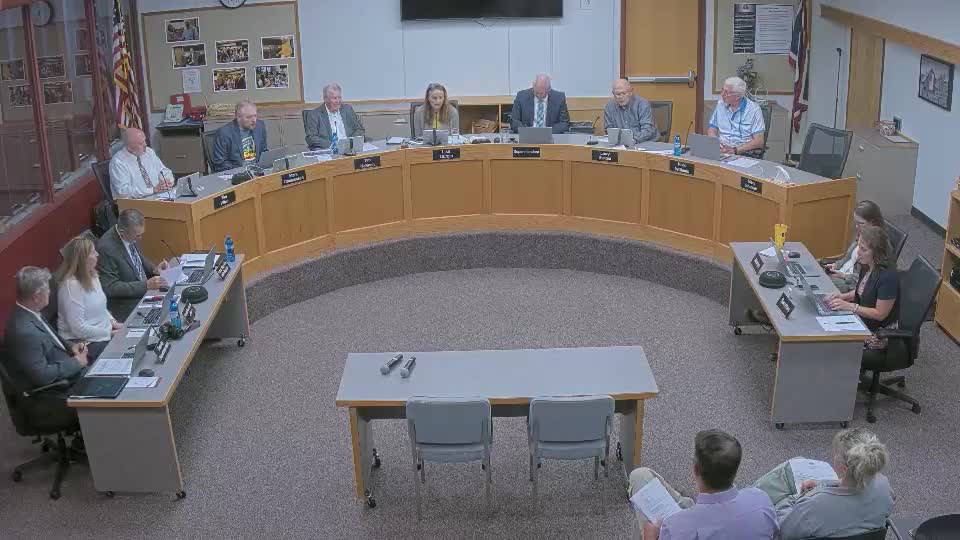
Summary
The board announced appointments to an armed educator committee and a staff recognition committee, and spent extensive time debating how to structure a district-wide review of its cell-phone policy — including whether to limit voting membership to three board members or use a broader, collaborative committee with an executive subgroup.
During its August 2025 meeting the Campbell County School District board established three committees — an armed educator committee, a staff recognition committee and a cell-phone policy committee — and appointed members to some of those groups while debating how the cell-phone review should be structured. Board members said the armed educator committee will implement recent state-level changes that removed gun-free school zones and will review applications from employees seeking armed-educator status. The board named the positions to be included on that committee and asked Larry Stikers to serve on it. Board members described two nonvoting consultant roles for the committee: a parent involvement coordinator and a member of law appointment (legal consultant). The board also announced a staff recognition committee co-chaired by Greg McHarwood and Silvia (surname not specified in the transcript), and invited ESP representative Jackie Golden and a certified staff representative (Miss Boggan in the transcript) to serve. The lengthiest discussion focused on a proposed review of the district cell-phone policy. Board member Emlen Adams recommended a small committee with three board members as the voting members and broad testimony from administrators, principals, teachers, students and parents. “I think the board should be the voting members on this committee,” Adams said, arguing elected members should make the final policy decision. Other board members advocated a blended, collaborative approach. Doctor Ayers said a small committee supported by administration and including representation from impacted groups — principals, teachers, a secondary student and parents — would provide stronger buy-in and practical implementation feedback. “A small committee, that admin can support with representation from those impacted, is probably more supportive on the back end,” Ayers said. Board members proposed a compromise: form a broader committee of stakeholders complemented by an executive committee (an “executive committee within that”) to do more tactical work and to develop recommendations for the larger group and the board. The chair then appointed an executive subgroup including Dr. Mallon, the chair herself, and Tim Elgin to draft the broader process and report back within a month. The transcript records the appointments and the discussion but does not show formal roll-call votes on committee structures. Several board members repeatedly emphasized that any final policy would be returned to the full board for hearings and formal action should changes be proposed.