Get Full Government Meeting Transcripts, Videos, & Alerts Forever!
Get email alerts on the Wmp Update Guidelines topic
No spam. Unsubscribe anytime.
Energy Safety seeks feedback on draft wildfire mitigation plan update requirements
Summary
The Office of Energy Infrastructure Safety held a public workshop reviewing a draft chapter that would define when and how electrical corporations submit updates to their wildfire mitigation plans; written comments are due by 5 p.m. Sept. 18.
The Office of Energy Infrastructure Safety held a public workshop to review draft wildfire mitigation plan (WMP) update requirements and invited stakeholders to submit written comments by 5 p.m. on Sept. 18, Energy Safety staff said.
Energy Safety described the draft chapter as a mechanism to let electrical corporations offer focused, streamlined changes to their last approved base WMPs — including redlined edits, a short WMP update document organized by six reportable categories, and supporting appendices that tie redline changes to the declared reportable updates.
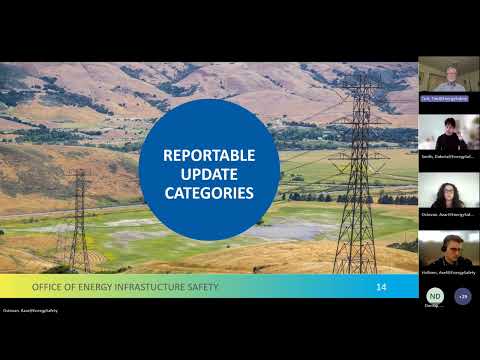
Presenters said the draft chapter sets six reportable update categories that an electrical corporation must address in an update: (1) areas for continued improvement, (2) risk models, (3) new or discontinued programs, (4) approved targets, (5) projected expenditures, and (6) administrative information. "The WMP update itself ... contains the portable updates, organized by these 6 required categories," Dakota Smith said during the workshop.
Staff emphasized that each reportable update must be reflected both in the WMP update narrative and in a redlined version of the base WMP, with a new appendix listing every change and its associated reportable category. Nicole Dunlap, program manager of Energy Safety's Electrical Safety Policy Division, opened the session and said the workshop was intended to "present and discuss the draft WMP update requirements chapter of the guidelines" and to solicit feedback to inform written comments.
Risk models and the reanalysis of the highest-risk circuits drew detailed guidance. Tim Tutt said the draft removes the prior "significant vs. nonsignificant" distinction for risk-model updates and limits risk-model reporting to changes tied to other reportable updates (for example, areas for continued improvement or approved target changes). For each reported risk-model change, staff said utilities must document methodology changes, reasons, supporting analysis, how prioritization and scheduling changed, and a summary of changes to the top 20% highest-risk circuits. The draft directs utilities to use a table template (table 2-1) and to submit an accompanying Excel spreadsheet with the full reanalysis; staff said the reanalysis narrative is limited to 20 pages.
Targets and how they can change were a frequent topic. The draft treats qualitative targets (formerly "objectives") as reportable when a status update occurs in the update year. Quantitative target increases are reportable when the utility anticipates a 15% or greater increase in the update year. Target decreases are allowed only in limited circumstances: (1) an earlier overachievement that preserves the three-year cumulative target, (2) a California Public Utilities Commission general rate case (GRC) decision with timing that justifies including changes in an update rather than a separate petition to amend, (3) as a downstream impact of another reportable update (for example, a risk-model change or program discontinuation), or (4) when the decrease still results in equal or greater risk reduction (for example, fewer outages). Tim Tutt and other presenters stressed that if a utility relies on a GRC decision to decrease a target, the update must also meet the petition-to-amend chapter requirements.
New or discontinued programs must be reported even if they do not affect the update year, staff said, but utilities must explain the reason for creation or discontinuation, downstream impacts, and where the new or discontinued program appears in the redlined base WMP. Utilities must identify whether a program is discontinued prematurely (not merely completed) to meet the draft definition of "discontinued."
Projected expenditures are reportable only when they result directly from another reportable update (for example, an approved target change) and then only at the mitigation-category level (for example, vegetation management), not at the individual program level. Staff offered a two-column table example (table 2-2) and limited the expenditures section to five pages. Administrative-information updates (also limited to five pages) should be included only when needed to evaluate the update or to clarify communications (for example, changes to responsible contacts, company reorganizations, or correction of a substantive typographical error that alters meaning).
Staff clarified several submission items in response to attendee questions. Maps tied to geospatial top-risk figures must be updated if a risk-model reportable update changes the information on those maps. The reanalyzed circuits table must be submitted in Excel format even if the WMP document presents only the top 20 lines. Staff acknowledged a typo in the draft (a reference to table 3-1) and said it will be corrected to table 2-1 in the final document. Energy Safety also said the evaluation process for updates will follow the criteria in chapter 2, section 4, of the WMP guidelines; nonreportable information in an update submission may lead to partial or full rejection and Energy Safety may allow resubmission or require retention of previously approved base-plan portions for denied items.
During the workshop staff took multiple questions about timing and compliance. Presenters said utilities should focus updates on the specific update year (for example, a 2027 update submitted in 2026 should focus on 2027 work and any downstream 2028 impacts). Staff clarified that a utility cannot reduce a future-year target based on an unfulfilled promise to catch up in a later year; only an overachievement already recorded by the time of the update can justify a later-year reduction while preserving the three-year cumulative target.
Presenters closed by reminding attendees that written comments on the draft chapter are due by 5 p.m. on Sept. 18 and must be filed in the WMP guidelines docket; comment letters are limited to 15 pages with supporting materials allowed as appendices. Energy Safety staff said they will consider submitted written comments in preparing the final chapter and will follow up with stakeholders on several data-template and Excel-file questions.
Energy Safety said it expects WMP submissions typically in spring, and that the agency will publish an initial schedule "ideally by the end of this calendar year." The workshop recording and slides were used to explain draft requirements and answer stakeholder questions.