Bothell staff report surge in development interest; council raises concerns about self-storage and minimum densities
September 10, 2025 | Bothell, King County, Washington
This article was created by AI summarizing key points discussed. AI makes mistakes, so for full details and context, please refer to the video of the full meeting. Please report any errors so we can fix them. Report an error »
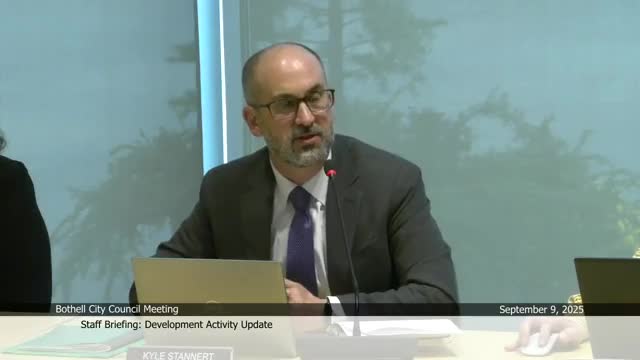
The update centered on three phases of development review — land‑use entitlement, construction permitting and built projects — and a new online construction project map staff use to show large public and private projects. “There are about 400 residential units still coming under former standards, and a newer wave of projects is beginning to appear,” Katz said, citing projects including Grama senior housing, 102 Main and the Jemco campus.
Why it matters: Councilors said the city’s policy choices affect whether new projects create active neighborhoods or inert uses. Several members raised the recent permitting of a self‑storage building on Bothell‑Everett Highway near Canyon Park as a cautionary example of a use that produces little street activity and could weaken the city’s goals for regional centers.
Council member Kurd asked whether minimum densities are “too high for things to pencil out” for some developers; Katz said developers have raised those questions but often respond by blending product types — for example pairing townhomes with stacked multifamily — to reach density goals. Council member Kurt and others asked staff to watch whether policies are producing the kinds of housing types the council intended under the 2024 comprehensive plan.
Council member Kurt and others suggested the city may need to study where certain low‑activity land uses should be allowed. “If there are land uses out there that are pretty opposed to what we’re trying to create … I would welcome a conversation about where we should and shouldn’t allow those types of things,” Kurt said, citing self‑storage and drive‑throughs as examples that can harm walkability.
Staff response and next steps: Katz told the council the development services team meets regularly with builders and that staff will return to the council with periodic updates — semiannual or annual — showing emerging patterns and examples of projects as they move into construction. Katz also said staff will track recurring obstacles in the permitting process and recommend code adjustments if needed.
No formal action was taken; the presentation was informational and staff will report back with more data and examples as projects progress.
View the Full Meeting & All Its Details
This article offers just a summary. Unlock complete video, transcripts, and insights as a Founder Member.
30-day money-back guarantee
Sponsors
Proudly supported by sponsors who keep Washington articles free in 2026

