
City proposes time-limited Helene recovery boards; volunteers offer to keep advisory boards active
Get AI-powered insights, summaries, and transcripts
Subscribe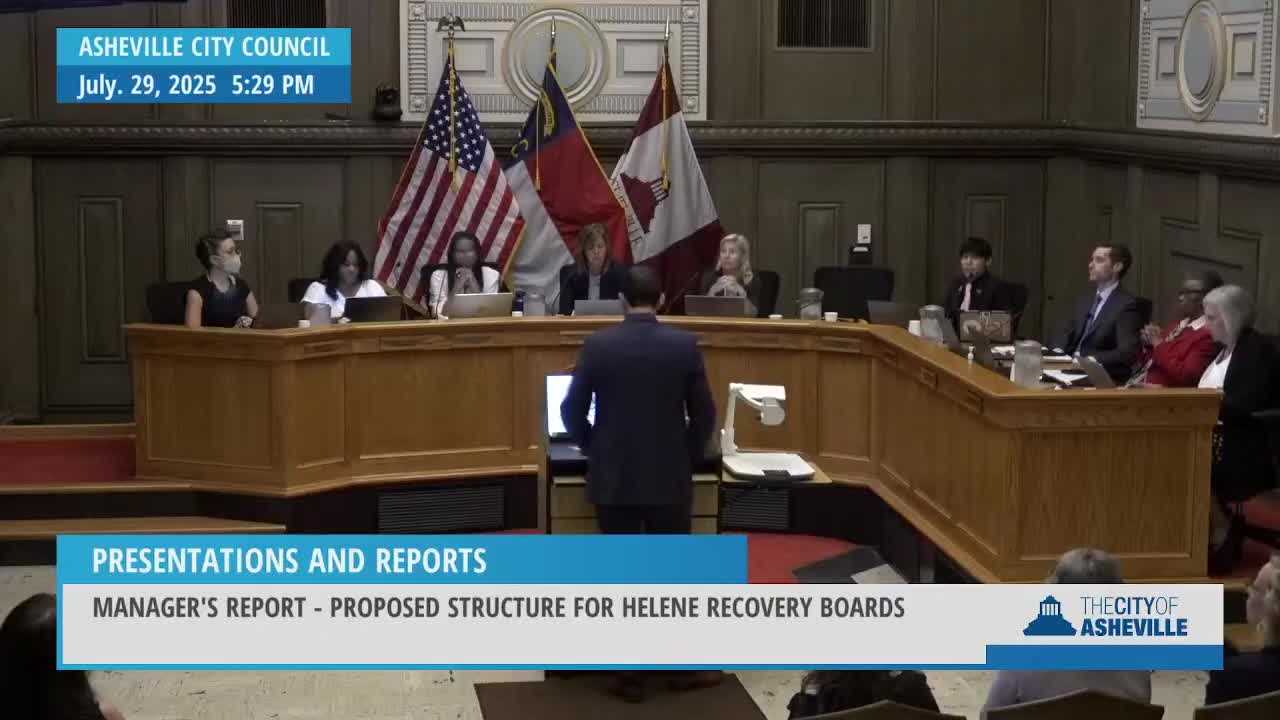
Summary
City staff proposed four time-limited 'Helene' recovery boards and a revised advisory-board process to prioritize recovery tasks; a volunteer Realignment Working Group offered free administrative support to keep advisory boards meeting during staff capacity constraints, and council voiced mixed reactions.
City staff proposed creating four time-limited Helene recovery boards to advance Asheville’s post-Helene recovery priorities and recommended restarting a smaller set of advisory boards on an as-needed basis. Assistant City Manager Ben Woody told council the recovery boards would be limited to 11 members each, draw existing advisory board leadership plus public appointments, be staff-supported and work from council committee-directed work plans.
Why it matters: The proposal is framed as a way to align public participation with council priorities during a period of heavy recovery work and constrained staff capacity. Staff said the boards would focus on people, housing, infrastructure and environment, and the economy — with an emphasis on infrastructure, environment and economic recovery in heavily impacted riverfront corridors.
Structure and schedule: Woody said the chairs and vice chairs (or their designees) from existing advisory boards would serve on recovery boards to ensure continuity and subject-area expertise. Staff recommended the framework be returned for an administrative and legal review at an agenda briefing on Aug. 21 and that council consider a resolution to establish the four Helene recovery boards at the Aug. 26 business meeting.
Council and public feedback: Several council members expressed concern about automatically appointing chairs and vice chairs to the recovery boards, arguing that chairmanship does not always correspond to the best technical expertise and that other assignment methods should be considered. Councilmember Roni said the Realignment Working Group’s volunteer proposal should be accepted; Roni characterized it as volunteer clerk support that could expand capacity during recovery.
Realignment Working Group offer: Stacy Anderson, representing the Realignment Working Group, urged council to accept a volunteer-driven plan to keep advisory boards meeting during the recovery without adding staff burden. Anderson said the group would provide scheduling, public access support, documentation, hybrid meeting tools, training and coordination “at no cost.” She said the model would maintain transparency, comply with open-meetings requirements, and help preserve institutional knowledge.
Legal concerns: City Attorney Brad cautioned that all advisory bodies are "public bodies" under North Carolina open meetings law and that legal counsel, public notice, minute-taking and training are part of the city’s legal risk management. Brad said community volunteers could assist but would still need regular interaction with city staff and the city attorney to avoid inadvertent violations and legal exposure for the city.
Decision status: Staff did not ask council to adopt the proposal at the meeting but said it would return with a legal and administrative framework at the Aug. 21 agenda briefing and a possible resolution on Aug. 26. Several council members signaled support for exploring a volunteer partnership but said more detail is needed before formal adoption.