
Council approves Springside subdivision rezoning after months of neighborhood negotiations; conditions added for buffer, stormwater and crosswalk
Get AI-powered insights, summaries, and transcripts
Subscribe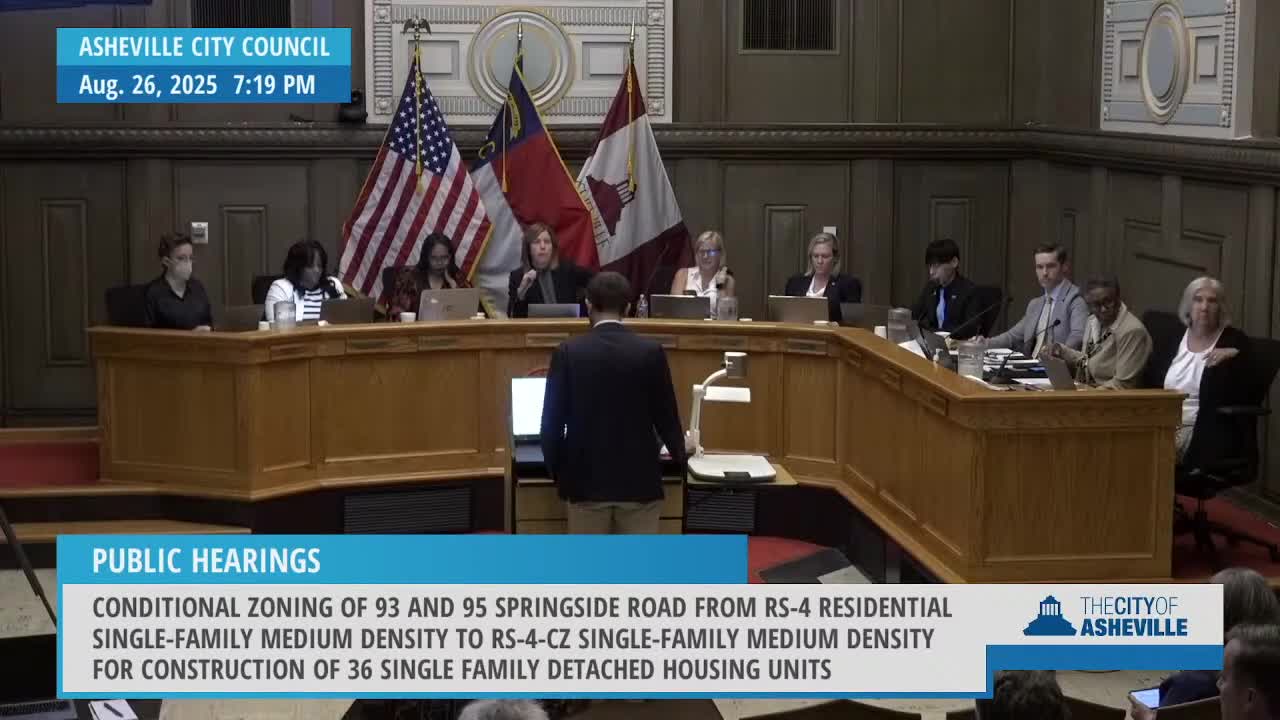
Summary
After extensive neighborhood mediation and public comment, City Council approved conditional rezoning for a 35-lot Springside subdivision at 93–95 Springside Road, adding conditions for enlarged tree/vegetative buffers, upsized stormwater detention and a crosswalk/traffic review; opponents warned of safety and infrastructure strain.
Asheville City Council voted Aug. 26 to approve a conditional rezoning allowing a 35-lot single-family subdivision on roughly six acres at 93 and 95 Springside Road, after months of revisions, public hearings and intense neighborhood engagement.
The project: Developer Sage Communities proposed an RS-4 conditional zone to modify standard lot-size, width and setback rules to allow smaller lots and closer building envelopes than a typical RS-4 subdivision. The plan presented a single main entrance to Springside Road, a proposed internal street (Bridal Road A), sidewalks along part of the frontage, and an upsized StormTech stormwater detention system designed to detain a 25-year storm event.
Why it mattered: The neighborhood voiced repeated safety concerns about pedestrian crossings near four schools, narrow road geometry, and longstanding stormwater/sewer vulnerabilities in the area. Council members and staff noted the city’s comprehensive-plan goals—walkable streets, stormwater mitigation and housing diversity—but staff also flagged environmental concerns about grading and the project’s footprint.
Negotiated conditions and council action: Planning staff recommended approval with conditions. In response to neighborhood demands and council questions, the applicant and neighborhood negotiated further changes before the vote. Those included reducing the project from 36 to 35 lots; adding a 20-foot vegetative buffer along the western property line adjacent to Spring Forest Circle (with the first 10 feet preserved as an undisturbed tree area and the next 10 feet meeting Type A planting requirements, allowing some plantings in the preserved area and crediting existing vegetation); upsizing stormwater detention; providing a crosswalk across Springside Road at a location coordinated with the city traffic engineer; and dedicating funds to future Springside Road sidewalk construction in lieu of building a sidewalk on the development’s stub road.
Public comment: More than two dozen neighbors and stakeholders spoke during the public hearing. Supporters stressed the city’s housing shortage and said the smaller single-family lots would add “missing middle” supply. Opponents said the plan exceeds RS-4 density and urged duplexes, townhomes or a rezoning to RMA to produce more diverse, affordable housing types; many also pressed for infrastructure assurances and voiced safety concerns about the road and school walkways.
Planning context and follow-up: Staff noted the development is somewhat denser than typical RS-4 areas (about six units per acre vs. the comprehensive-plan guideline of 3–5 units/acre) and encouraged that future projects provide a better mix of housing types and improved open-space amenities; council members stressed the need to prioritize safe pedestrian infrastructure and to coordinate on sidewalk funding. Legal counsel noted a pending ownership dispute on a small strip of the property; the ordinance was approved with language that it would not take effect until ownership issues are resolved.
Outcome and next steps: The council adopted the conditional rezoning, with conditions as negotiated. Staff will follow up on crosswalk design, stormwater implementation, and the sidewalk funding mechanism; the zoning change will only become effective once the outstanding property title issue is resolved.
Ending: The vote advances a contentious infill proposal that neighborhood leaders and the developer negotiated through multiple revisions; the conditions focus city and developer attention on buffers, stormwater and pedestrian safety as the project moves into permitting and construction planning.