
Council agrees to draft RV‑park design guidelines, plans small committee and outreach to operators
Get AI-powered insights, summaries, and transcripts
Subscribe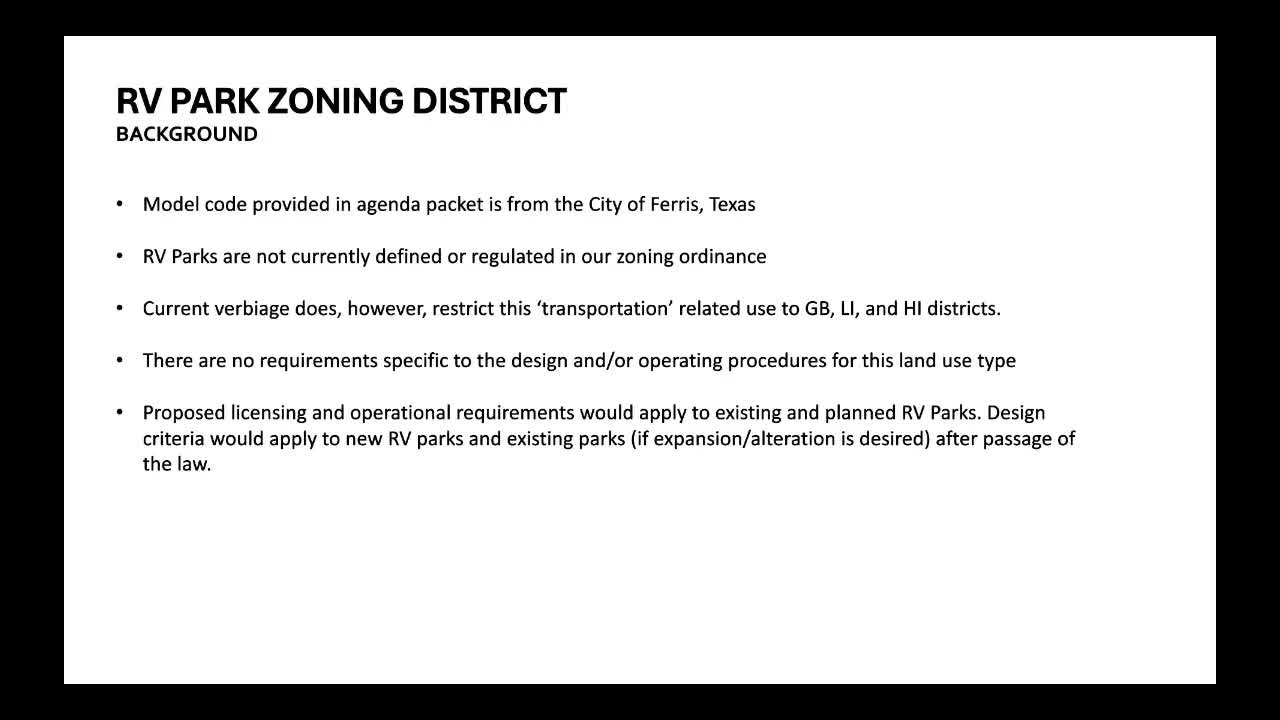
Summary
Councilmembers discussed how to regulate new RV parks, including whether to create a zoning district or adopt land‑use standards. They agreed to form a small committee to draft local guidelines and to invite existing RV‑park operators to advise on safety, sewage and screening requirements.
Council members opened a discussion Aug. 28 on whether and how the city should regulate new RV parks after several developers expressed interest in locating parks near commercial corridors. Council members and the city administrator agreed the city currently lacks specific local guidelines for RV parks and that some form of land‑use rules are needed to set safety, utility and siting expectations.
The issue: council members said prospective RV‑park operators receive limited guidance from city staff because the city’s zoning ordinance does not specifically define RV parks or set minimum design criteria. A staff handout included model language borrowed from Ferris, Texas, which council members said could be a starting point for local rules.
Options discussed: participants debated two main approaches — create a distinct RV‑park zoning district that would control where parks can be located, or adopt performance and design standards and assign RV parks to suitable existing commercial or industrial zones. Council members expressed concern about parks sited next to residential lots, noise from generators and safety issues such as shore‑power and electrical clearances.
Operator input and grandfathering: council members said any new regulations would not affect the town’s existing RV park, which would be grandfathered. Several council members suggested inviting Nancy, a local RV‑park operator, to advise the committee because operators can identify practical safety and management rules (for example, the existing park prohibits generators on site).
Committee and next steps: council directed staff to form a small drafting committee of council members and to invite at least one experienced operator and an ADC representative to consult. Staff will prepare a proposed committee makeup and bring it back for scheduling; a draft ordinance or land‑use amendment would return to council for public hearing and formal adoption if the committee recommends changes.
Why it matters: RV‑park siting and standards affect nearby neighborhoods (noise, lighting, sewage) and municipal decisions about sewer, utility extensions and land‑use compatibility. Council members said clear, local guidelines will give staff a consistent basis to process applications and reduce ad hoc outcomes.