
Costs top the debate: advocates point to municipal budget pressure; researchers cite divergent state and international findings
Get AI-powered insights, summaries, and transcripts
Subscribe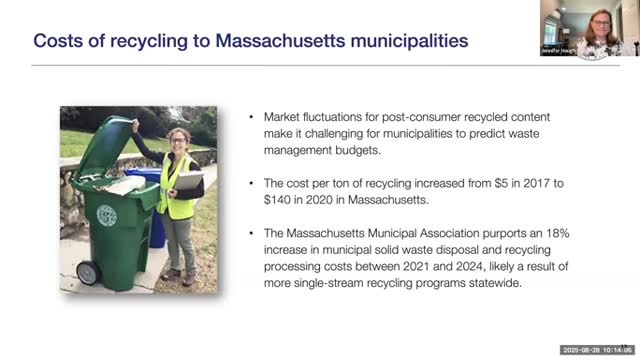
Summary
Participants debated program costs, consumer impacts and international precedents. Several speakers urged Massachusetts to study multiple cost analyses; others warned administrative costs and program designs can drive significant budget increases in jurisdictions with EPR systems.
Advisory group members identified program cost as a central uncertainty and potential barrier to EPR implementation. Participants pointed to sharp increases in recycling processing costs over recent years, differences in methodology in cost studies, and contrasting experiences in other jurisdictions.
Speakers cited several illustrative findings (as discussed in the meeting): EPA and The Recycling Partnership reported different national recycling-rate figures, while the presentation attributed a spike in processing costs to the combination of China’s 2018 National Sword policy and changing market and operating models for materials recovery facilities. One presenter said tip fees rose dramatically in a short period (the presentation referenced a rise from “$5 in 2017 to $140 in 2020” but did not specify the unit in the slide or transcript). Participants therefore flagged that units and denominators must be made explicit when summarizing costs.
Participants offered differing perspectives:
• Several municipal representatives and advocates (including Claire and Juanita) said current municipal purchasing and fragmented systems (351 municipalities with separate contracts) are inefficient and are producing rising costs for ratepayers; some municipalities recently raised rates by 40% in response to recycling cost increases.
• Industry representatives and haulers warned that EPR can add administrative overhead and that much of the projected cost increases in some jurisdictions were driven by administrative and program-management expenses rather than physical collection and processing; they advocated for independent third-party handling of proprietary data and cautioned that producers may refuse to share data without statutory confidentiality protections.
• Canadian and academic participants (Calvin and others) described large cost escalations in Canadian provincial programs. One speaker summarized Ontario’s experience: program costs have increased substantially over decades (cited tripling between 2002 and 2020 and a doubling 2020–2024 in one participant’s presentation), and the Ontario government recently narrowed aspects of its EPR law because of cost concerns.
Speakers asked the advisory group to collect and compare cost studies — for example, Colorado and California regulatory impact analyses and actual PRO plan costs from Oregon and other U.S. states — and to request producers, municipalities and independent analysts to present methodology and assumptions so the commission can compare net effects, including likely consumer pass-through, municipal budget impacts and impacts on haulers and recyclers.
No consensus emerged about consumer price impacts; some presenters cited studies suggesting consumer costs would rise, while others (including producer advocates) said EPR need not increase consumer prices and that design choices and fee allocation affect outcomes. Participants recommended the commission obtain a suite of cost studies and, where possible, standardized assumptions to support apples-to-apples comparisons.