
Advisory group reviews extended producer responsibility for plastics and packaging; background paper due to commission
Get AI-powered insights, summaries, and transcripts
Subscribe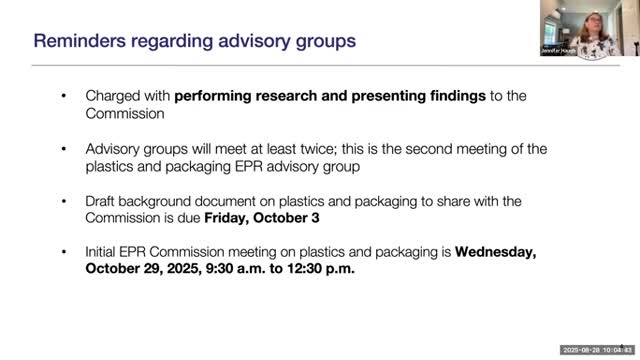
Summary
The MassDEP advisory group on plastics and packaging met to review preliminary findings about extended producer responsibility (EPR), identify data gaps and frame pros and cons. Members agreed a background document will be finalized for the EPR commission by Friday, Oct. 3, ahead of the commission meeting on Oct. 29.
The Massachusetts advisory group on plastics and packaging met online to review preliminary findings about extended producer responsibility for packaging, to identify missing data, and to surface early pros and cons. The group, facilitated by Greener U, said a background document is due Friday, Oct. 3, and will be delivered to the EPR commission before the commission’s meeting on Wednesday, Oct. 29.
The meeting matters because Massachusetts is considering an EPR approach that would shift financial responsibility for recycling packaging from municipal taxpayers to producers, and because the commission must weigh trade-offs including recycling access, data quality, program costs and governance. The background paper is intended to give the commission a concise set of talking points and an evidentiary foundation for future decisions.
Advisory group facilitator Jen Hauck, vice president of planning for Greener U, said this was the plastics and packaging group’s second meeting and likely its last; participants were asked to add names and affiliations in the chat to clarify who was representing which stakeholder groups. MassDEP staff and outside experts joined the discussion; presenters flagged that the briefing was compiled quickly from volunteer submissions and public sources earlier in the week and may be revised.
Participants spent most of the session on three themes: (1) data and measurement, including divergent recycling-rate estimates and gaps for households not served by municipal programs; (2) the magnitude and drivers of recycling and post-collection costs, including references to China’s National Sword policy and municipal tip-fee increases; and (3) governance questions about producer responsibility organizations (PROs), reporting/confidentiality of industry data, and potential impacts on local haulers and recycling operators.
No formal votes or policy decisions were taken at the meeting. Instead, the group identified follow-up tasks (data clarifications from DEP and other contributors) and recommended additional research, including inviting producers, municipal representatives and researchers to present specific cost and methodology studies.
The advisory group will incorporate feedback and submit a revised background document to the commission on Oct. 3; the commission’s next meeting is scheduled for Oct. 29, when the commission will review advisory materials and consider next steps.