
Wellington staff recommends streamlined administrative rules for EV chargers, backs limited turf prohibitions to meet state laws
Get AI-powered insights, summaries, and transcripts
Subscribe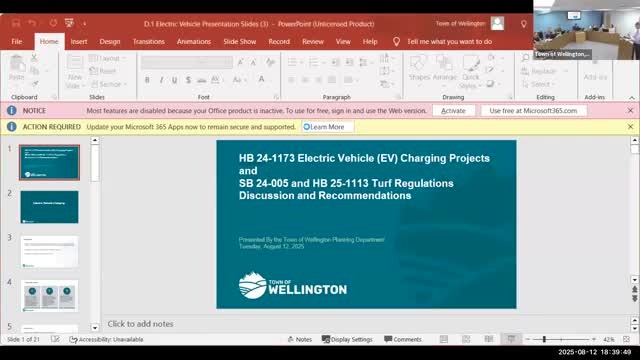
Summary
Planning Director Cody Byrd asked trustees Aug. 12 to direct staff to adopt a minimal, administrative permitting approach for electric vehicle (EV) charging projects under HB 24-1173, and to begin code amendments to prohibit nonfunctional and artificial turf in specified property types to comply with SB 24-0005 and HB 25-1113.
Wellington planning staff recommended a two-part approach to comply with multiple recent state laws during a presentation to the Board of Trustees on Aug. 12.
Why it matters: New state laws require municipalities to change how they permit EV charging projects and to restrict nonfunctional turf and artificial turf in several types of properties. The town must act on some requirements before the end of the year and on others by Jan. 1, 2028.
Cody Byrd, Wellington's planning director, told trustees the town is a "subject municipality" under HB 24-1173 and must adopt a path for reviewing EV charging proposals. Byrd said staff's recommended approach (staff'preferred Option 2) is to adopt objectively written, minimum administrative-permit standards; that would require administrative approvals (no public hearings) for charger installations and clear published checklists for applicants. Byrd said the model code option would be more extensive than Wellington needs, and the opt-out/alternative option risks additional state enforcement or future rulemaking.
Byrd said Wellington currently has one EV charger (at the Maverik site) that was handled administratively with a building permit. He said the proposed local approach is to define EV chargers in the land-use code, differentiate primary-use charging (standalone charging lots) from accessory-use charging (charging spaces at existing businesses), and adopt an administrative approval process that permits accessory charging in most zone districts but limits primary-use standalone charging to commercial and industrial zones in order to protect constrained downtown parking.
Trustees asked about utility capacity and coordination with power providers. Byrd said staff will engage Xcel Energy and Poudre Valley REA and the town's building and fire reviewers to determine what referrals, proof of service or infrastructure verification are required on the application checklist. He noted Wellington has seen limited demand to date and staff believes providers can accommodate typical requests but will confirm during code drafting.
On landscaping and turf, Byrd summarized two related laws. SB 24-0005 requires municipalities to prohibit nonfunctional turf, artificial turf and specified invasive plant species for new development and redevelopment in commercial, industrial, civic, streetscapes and HOA common areas by the end of 2025. HB 25-1113 extends requirements to residential properties (12+ units and multifamily) and requires municipalities to adopt irrigation and turf regulation for residential property types by Jan. 1, 2028. Byrd said Wellington's existing Landscape and Irrigation Design Manual addresses water-wise design but needs language changes to conform with new statutory terms such as "functional turf" (sports/play areas) and "nonfunctional turf" (decorative turf that is not intentionally for recreation).
Staff recommended drafting code amendments this fall to prohibit nonfunctional and artificial turf in the locations identified by the first act and to update definitions. Byrd proposed postponing a comprehensive update to the landscape manual and residential regulations until 2026'27 to align with a required water-supply element to the town's comprehensive plan under SB 24-174.
Trustees offered mostly positive feedback for the streamlined administrative approach to EV charging and supported staff's recommended timeline for turf/code changes. Several trustees favored option 2 for EV chargers to minimize staff time and avoid imposing conditional-use hearings that HB 24-1173 forbids for these projects. Trustees requested staff to return draft language and to coordinate with utility providers, the fire district and building inspectors on referral requirements and standards.
No formal ordinance was adopted at the Aug. 12 meeting; staff will prepare draft code language, an administrative policy/checklist for EV charging, and public hearing materials for the planning commission and board as appropriate.