
Board backs study of grade‑separated rail crossing and asks staff to publicize evacuation routes including Wisconsin Avenue
Get AI-powered insights, summaries, and transcripts
Subscribe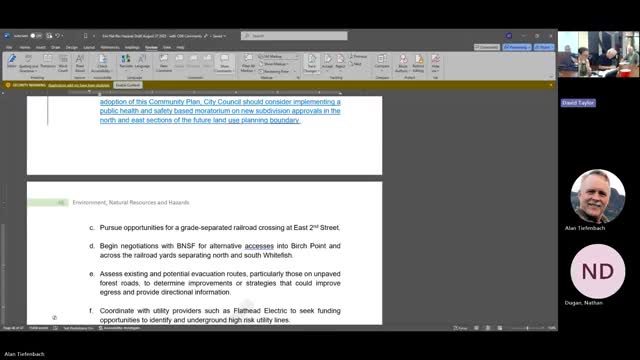
Summary
The planning board reaffirmed support Aug. 27 for pursuing a grade‑separated railroad crossing at East Second and approved objectives to publicize evacuation routes and analyze Wisconsin Avenue’s viability for vehicle evacuation from lakeshore and Big Mountain areas.
Planning board members on Aug. 27 reiterated support for pursuing a grade‑separated railroad crossing at East Second Street and asked staff to publicize evacuation routes and analyze whether Wisconsin Avenue could be used for evacuation from East Lakeshore Drive and Big Mountain when needed.
Viaduct/grade separation: status and next steps Board members noted the viaduct or grade‑separated railroad crossing has been discussed for years and is a high priority in transportation visioning. Staff reported that a transportation grant and consultant work already under way address viaduct options; the board kept an objective in the hazards chapter that directs pursuing opportunities and coordinating with relevant agencies. The board did not adopt a separate, board‑funded engineering bore‑scope study; instead staff said existing transportation study work will cover feasibility and cost considerations.
Evacuation routes and Wisconsin Avenue In response to public and board questions about evacuation of resort and lakeshore areas, the board approved adding language to publicize evacuation routes and to analyze whether and how Wisconsin Avenue could be used to evacuate vehicles from East Lakeshore Drive and Big Mountain in the event of an incident. The board clarified that evacuation plans will be zone‑based and that the fire department and incident commanders would adapt routes during an actual event; members also said emergency‑route planning should be widely publicized so residents and visitors understand likely evacuation behavior.
Legal and liability context Participants cautioned about statements that would represent the city as guaranteeing any single route would safely evacuate all vehicles. Staff noted the city attorney had advised that claiming a single corridor could evacuate all vehicles in every scenario raises liability concerns; the board therefore framed the objective as analysis and public information rather than an assurance that Wisconsin Avenue will always be sufficient.
BNSF and rail coordination Board discussion acknowledged that any grade separation requires coordination with BNSF and federal and state agencies, that prior transportation plans identified high costs, and that grant funding and phased approaches are typical. Staff said the current transportation grant work will feed detailed cost and funding discussions; the hazards chapter retains an objective to pursue grade separation opportunities as part of the transportation program.
Outcome The board left objectives in place to pursue grade separation and approved text instructing staff to publicize evacuation routes, analyze Wisconsin Avenue’s role in evacuation planning and return with transportation study findings. The board did not create any immediate obligations on private property owners or on rail owners; instead, it endorsed interagency coordination and information for the public.